Pursuing a Master of Science (MS) in the USA continues to be one of the most popular academic choices for international students, especially from countries like India, China, Nepal, Bangladesh, and Nigeria. As of 2026, the United States hosts over 1.1 million international students, and nearly 45 – 48% of them are enrolled in STEM-related master’s programs, including Computer Science, Data Science, Engineering, Artificial Intelligence, and Business Analytics. Eligibility for MS in USA refers to the complete set of academic, language, test, financial, and profile-related criteria that international students must meet to pursue a master’s degree in the United States.
Key Highlights: Eligibility for MS in USA
- General Eligibility Criteria for MS in USA
- Academic Eligibility for MS in the USA
- Eligibility for MS in the USA for Indian Students
- English Language Proficiency Requirements
- Standardized Test Requirements (GRE & GMAT)
- Work Experience Eligibility for MS in the USA
- Specialization-wise Eligibility for MS in the USA
- Document Requirements for MS in the USA
- Financial Ability & Proof of Funding
- Conclusion
- FAQs
Want to Study in Europe?
Start your journey with Successcribe’s free expert guidance
Book a Free Session NowGeneral Eligibility Criteria for MS in USA
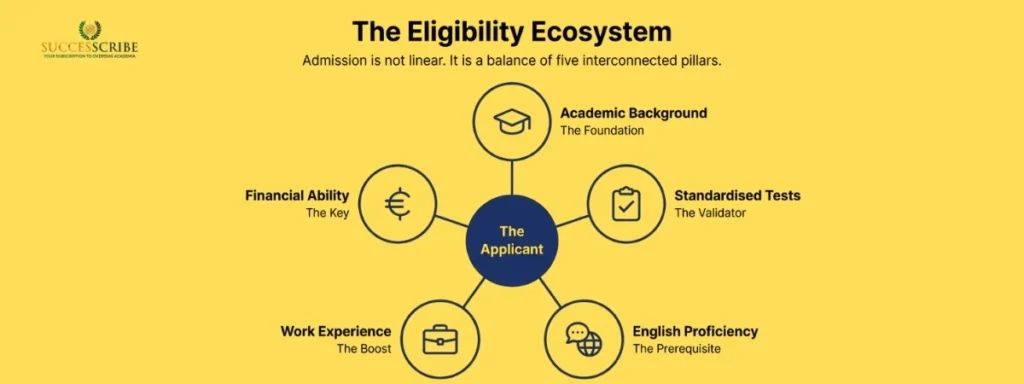
Academic eligibility for MS in USA evaluates whether a student’s undergraduate education, grades, and subject background adequately prepare them for the academic rigor of a master’s program.
General Requirements:
- A recognized bachelor’s degree
- Minimum GPA or percentage
- English language proficiency
- Standardized test scores (if required)
- Relevant academic background
- Financial proof
There is no centralized admission system in the USA. Each university sets its own eligibility rules.
Academic Eligibility for MS in the USA
Academic eligibility is the foundation of your MS application to the USA. US universities primarily assess whether your undergraduate education, grades, and academic background prepare you for the rigor of a master’s-level program. Eligibility for MS in USA is strongly influenced by academic factors such as undergraduate degree type, GPA, subject relevance, and overall academic consistency. In 2026, universities continue to follow a holistic evaluation approach, meaning strong academics can significantly improve your admission chances – even if other areas of your profile are average.
Bachelor’s Degree Requirement for MS in USA
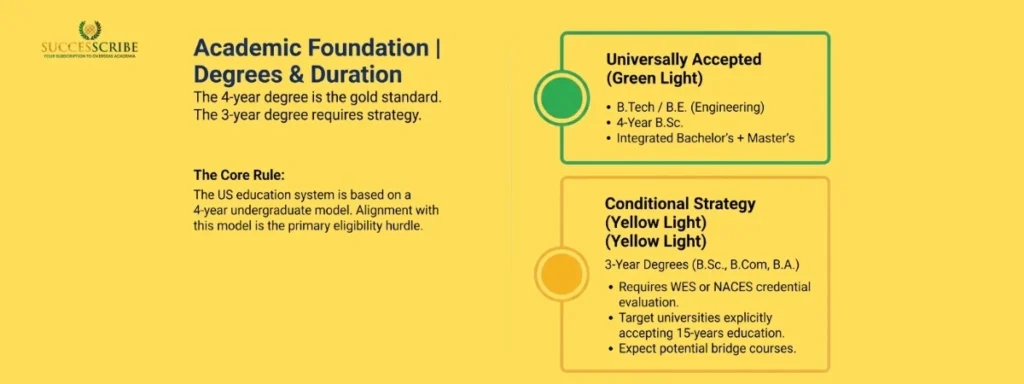
To be academically eligible for an MS in the USA, applicants must have completed a recognized undergraduate degree from an accredited institution.
Accepted Undergraduate Degrees:
- B.Tech / B.E. (Engineering streams)
- B.Sc. (4-year programs)
- BCA (commonly accepted for MS in Computer Science & IT)
- Integrated Bachelor’s + Master’s degrees
- Equivalent international qualifications
Most US universities prefer a 4-year bachelor’s degree, as it aligns with the American education system.
What About 3-Year Degrees?
In 2026, students with 3-year bachelor’s degrees (such as B.Sc. or B.Com) may still be eligible for MS in USA under certain conditions:
- Admission to select universities only
- Mandatory credential evaluation (WES or NACES)
- Completion of bridge courses or prerequisite subjects
- Strong academic and professional profile
Students with 3-year degrees should shortlist universities carefully, as acceptance varies widely.
Minimum GPA Requirements for MS in USA
The Grade Point Average (GPA) is one of the most critical academic criteria for MS admissions. US universities evaluate GPA on a 4.0 scale, regardless of the grading system used in your home country.
General GPA Expectations (2026):
- Top-tier universities: 3.5+/4.0
- Mid-ranked universities: 3.0 – 3.4
- Moderately competitive universities: 2.7 – 2.9
- Flexible universities: 2.5 – 2.6 (with strong profile support)
Many universities clearly state a minimum GPA, but competitive programs often admit students with higher GPAs than the minimum required.
Indian CGPA to US GPA Conversion Table
| Indian CGPA / Percentage | Approx. US GPA | Admission Competitiveness |
| 8.5 – 10.0 CGPA | 3.7 – 4.0 | Highly Competitive |
| 7.5 – 8.4 CGPA | 3.3 – 3.6 | Very Strong |
| 6.5 – 7.4 CGPA | 3.0 – 3.2 | Competetive |
| 6.0 – 6.4 CGPA | 2.7 – 2.9 | Moderate |
| Below 6.0 CGPA | Below 2.7 | Limited Options |
GPA conversion is not standardized. Universities may use internal formulas or third-party credential evaluators.
Subject & Academic Background Requirements
Apart from GPA, US universities evaluate whether your academic background aligns with the MS specialization you are applying for.
Examples:
- MS in Computer Science:
Requires prior coursework in programming, data structures, algorithms, mathematics, or IT-related subjects.
- MS in Engineering:
Bachelor’s degree in the same or closely related engineering discipline.
- MS in Data Science / AI:
Strong foundation in mathematics, statistics, programming, or analytics.
- MS in Business Analytics:
Quantitative background preferred (engineering, economics, statistics, business).
Students from non-traditional or non-matching backgrounds may still qualify if they demonstrate relevant skills through certifications, projects, or work experience.
Dealing with Backlogs (KTs)
One of the most common myths is that backlogs disqualify you. In 2026, the policy is: Backlogs are allowed, but they must be cleared.
- Active vs. Inactive: You cannot get a visa or an I-20 with an active (pending) backlog. All subjects must be cleared before you enroll.
- Number of Attempts: Universities calculate backlogs by “attempts.” For example, if you failed Math once and cleared it the second time, it counts as 1 backlog.
- Tolerance Levels:
- Elite Schools: Prefer 0 backlogs.
- Mid-Tier: Accept 2 – 5 backlogs.
- Flexible Schools: Some universities (e.g., Wichita State, Kent State) may accept up to 10 – 15 backlogs if the overall GPA remains above 2.75.
Subject-Specific Prerequisites
Eligibility isn’t just about your overall score; it’s about what you studied. If you are switching fields (e.g., Mechanical Engineering to Data Science), you must meet Prerequisite Requirements.
Example: To be eligible for an MS in Computer Science in 2026, most universities require you to have completed undergraduate coursework in:
- Data Structures & Algorithms
- Operating Systems
- Calculus and Linear Algebra
- Computer Architecture
If you lack these, the university may offer Conditional Admission, requiring you to take “Leveling Courses” in your first semester.
Role of Academic Transcripts & Credential Evaluation
Applicants must submit official academic transcripts listing:
- Subjects studied
- Grades or marks obtained
- Degree completion status
Some universities require credential evaluation reports from agencies such as:
- WES (World Education Services)
- NACES-approved evaluators
Credential evaluation helps universities:
- Convert grades into US GPA format
- Verify degree equivalency
- Assess academic rigor
Can Low GPA Students Still Be Eligible?
Yes. In 2026, many universities take a holistic approach, considering:
- Strong GRE scores (if submitted)
- Relevant work experience
- Research publications
- Strong Statement of Purpose (SOP)
- Letters of Recommendation (LORs)
A low GPA does not automatically disqualify you – it simply requires strategic university shortlisting and profile strengthening.
Eligibility for MS in USA for Indian Students
Eligibility for MS in USA for Indian students involves additional considerations such as AICTE/UGC recognition, CGPA conversion, and credential evaluation requirements. Indian students form the largest international student group in the USA, accounting for over 25% of total international enrollments in 2026.
Specific Eligibility Factors for Indian Students
- AICTE/UGC recognized bachelor’s degree
- Strong quantitative background
- English proficiency proof
- Credential evaluation (WES/NACES for some universities)
Typical Indian Student Profile (Admitted)
- CGPA: 7.0 – 8.5
- IELTS: 6.5 – 7.5
- GRE (if required): 305 – 320
- Relevant projects/internships
Indian students with average academics but strong profiles still secure admits due to holistic evaluation.
English Language Proficiency Requirements
Eligibility for MS in USA requires international students to demonstrate English language proficiency through approved tests to ensure academic success in English-taught programs. Since MS programs in the USA are taught in English, proving language proficiency is mandatory for most applicants.
Accepted English Tests
- IELTS
- TOEFL iBT
- Duolingo English Test (DET)
Minimum Score Requirements
| Test | Minimum Score | Top Universities |
| IELTS | 6.5 overall | 7.0 – 7.5 |
| TOEFL iBT | 6.5 overall | 100+ |
| Duolingo | 6.5 overall | 120+ |
IELTS Band-wise Expectations:
- Listening: 6.5+
- Reading: 6.0+
- Writing: 6.0+
- Speaking: 6.0+
English Test Waivers
Some universities waive English tests if:
- Bachelor’s degree was taught entirely in English
- Student studied in an English-speaking country
- Medium of instruction certificate is provided
Waivers are university-specific, not guaranteed.
Standardized Test Requirements (GRE & GMAT)
As of 2026, 65–70% universities have made GRE optional, Top universities still recommend or prefer GRE. GMAT is usually required for MS in Management and Business Analytics.
Typical GRE Score Range:
- Quantitative: 155 – 165
- Verbal: 145 – 155
- Analytical Writing: 3.0 – 4.5
Typical GMAT score: 550 – 650
| University Tier | GRE Score Range |
| Top 50 | 320 – 330 |
| Top 100 | 310 – 319 |
| Mid-tier | 300 – 309 |
| GRE-waived | Not Required |
Work Experience Eligibility for MS in USA
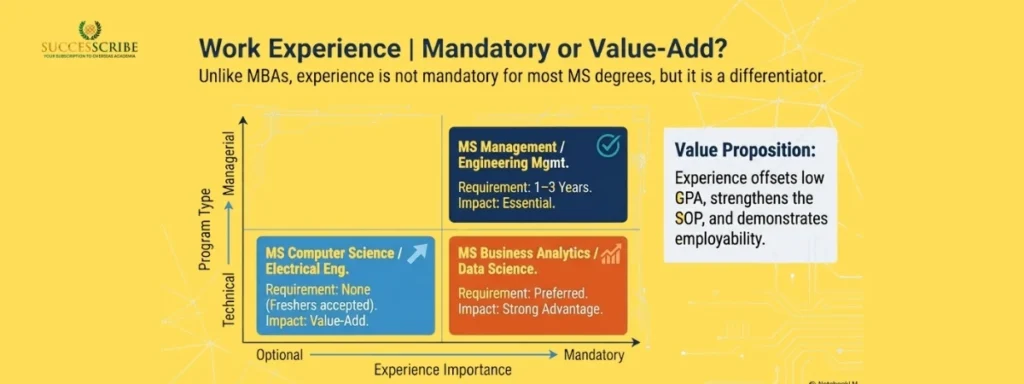
Unlike MBA programs, work experience is NOT mandatory for most MS programs in the USA. However, in 2026, relevant work experience is increasingly valued – especially for competitive universities and applied specializations.
Is Work Experience Required for MS in USA?
| MS Program Type | Work Experience Requirement |
| MS in Computer Science | Not mandatory |
| MS in Engineering | Not mandatory |
| MS in Data Science | Preferred but optional |
| MS in Business Analytics | Often preferred (1 -3 years) |
| MS in Engineering Management | Strongly Preferred |
| MS in Management | Usually required (1–3 years) |
Fresh graduates form over 60% of MS admits in STEM programs in the USA.
How Work Experience Helps in MS Admissions
Work experience can:
- Compensate for low GPA
- Strengthen SOP and LORs
- Improve chances at top-ranked universities
- Help in internship & job placements
Accepted Types of Experience:
- Full-time employment
- Paid or unpaid internships
- Research assistantships
- Startup or entrepreneurial experience
| Experience Duration | Admission Impact |
| 0 years | Fully Acceptable |
| 6–12 months | Positive |
| 1–3 years | Strong Advantage` |
| 3+ years | Ideal for management – oriented MS |
Specialization-wise Eligibility for MS in the USA
Eligibility for MS in USA varies by specialization, with universities assessing subject background, prerequisite coursework, and technical skill alignment for each program.
| MS Specialization | Academic Background | GPA Range | Test Preference |
| MS in Computer Science | CS, IT, BCA, Engineering | 3.0 – 3.7 | GRE optional |
| MS in Data Science | Math, CS, Stats, Engg | 3.0 – 3.6 | GRE optional |
| MS in Artificial Intelligence | CS, Math-heavy Engg | 3.2 – 3.8 | GRE preferred |
| MS in Engineering | Same discipline | 3.0 – 3.5 | GRE optional |
| MS in Business Analytics | Quant / Business | 3.0 – 3.6 | GMAT/GRE |
| MS in Engineering Management | Engineering + Experience | 3.0 – 3.5 | GRE/GMAT |
Core Prerequisites by Specialization
| Program | Key Prerequisite Subjects |
| MS Computer Science | Programming, DSA, Math |
| MS Data Science | Statistics, Python, SQL |
| MS Artificial Intelligence | Linear Algebra, ML |
| MS Engineering | Core engineering subjects |
| MS Business Analytics | Statistics, Economics |
Missing prerequisites may require bridge courses or conditional admission.
Document Requirements for MS in USA
The document requirements for MS in the USA form a crucial part of the admission process. Even if a student meets all academic and test-related eligibility criteria, incomplete or poorly prepared documents can lead to rejection.
In 2026, US universities follow a holistic and document-driven evaluation process, where academic records are assessed alongside purpose, recommendations, and profile strength.
Mandatory Document Checklist
Documents play a critical role in determining eligibility and admission success.
| Document Category | Required |
| Academic Transcripts | Yes |
| Degree Certificate | Yes |
| Statement of Purpose (SOP) | Yes |
| Letters of Recommendation (LORs) | Yes |
| Resume / CV | Yes |
| English Test Scores | If Applicable |
| GRE / GMAT Scores | If Applicable |
| Passport Copy | Yes |
| Financial Documents | Yes |
Financial Ability & Proof of Funding
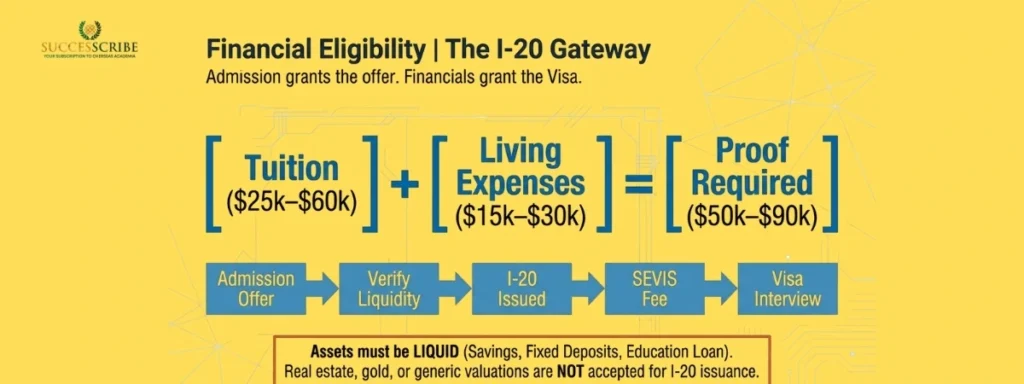
To receive a Form I-20 for the F-1 student visa, you must prove sufficient financial resources for at least the first year of study. This is a strict eligibility requirement.
Estimated Costs
- Tuition & Fees: Public Universities: $25,000 – $40,000; Private Universities: $35,000 – $60,000+.
- Living Expenses: Varies by location: $15,000 (small town) to $30,000+ (major cities like NYC, SF, Boston).
- Total Proof Required: Often $50,000 – $90,000 for the first year.
Accepted Proof: Personal/family bank statements (3-6 months), official loan sanction letters, affidavits of support, or scholarship letters.
Demonstrating Financial Capability for I-20
After admission, universities issue I-20 forms only after verifying financial capability. This process has specific documentation requirements and timelines.
I-20 Financial Documentation Process
| Step | Timeline | Required Documents | Common Issues | Resolution |
| Receive Admission | Decision date | – | – | |
| Financial Document Request | Within 1 week of admission | Financial certification form, supporting documents | Form not received | Contact international student office |
| Document Preparation | 2-3 weeks | Bank statements (6 months), sponsor affidavits, loan letters, scholarship confirmations | Insufficient funds shown | Combine multiple sources clearly |
| Submit Financial Docs | Within deadline | All required documents via portal | Format errors, missing signatures | Resubmit corrected documents |
| Verification Review | 1-2 weeks | – | Additional documents requested | Respond within 48-72 hours |
| I-20 Issuance | After approval | – | Delayed processing | Follow up with email |
| Receive I-20 | 1-2 weeks after issuance | – | Lost in mail | Request electronic I-20 |
| SEVIS Fee Payment | After I-20 receipt | SEVIS fee ($350) | Payment errors | Keep receipt for visa interview |
Financial Document Specifications for I-20
| Document Type | Must Show Amount | Date Requirements | Signature Requirements | Common Mistakes |
| Bank Statement | First year total cost minimum | Last 3-6 months | Bank stamp/seal | Showing fixed deposits only |
| Bank Letter | Available liquid balance | Dated within 6 months | Bank manager signature on letterhead | Generic letters |
| Sponsor Affidavit | Specific commitment amount | Notarized recently | Notary public seal | Missing relationship proof |
| Scholarship Letter | Award amount and duration | Official award letter | University/organization signature | Conditional offers unclear |
| Loan Approval | Approved/disbursable amount | Recent approval | Lender signature | Pre-approval vs. final approval |
Conclusion
Eligibility for MS in USA goes beyond minimum cut-offs and depends on how well a student’s academics, experience, documents, and goals align with university expectations. It is about crafting a compelling, coherent, and competitive profile in a landscape that values specificity, authenticity, and demonstrated ability. While a high GPA and test scores open doors, it is the synergy of your academic foundation, relevant experience (projects/internships), a tailored and insightful SOP, and strong recommendations that secures admission. The process is rigorous and demands meticulous planning over 12-18 months.
FAQs
Is GRE compulsory for MS in USA in 2026?
No. In 2026, around 65–70% of US universities have made GRE optional for MS programs. However, top-ranked and competitive universities still recommend or prefer GRE, especially for Computer Science, AI, and Engineering. Submitting a strong GRE score can significantly improve chances for students with average GPA or non-traditional backgrounds.
Can I pursue MS in USA with a 3-year bachelor’s degree?
Yes, but with limitations. Students with 3-year degrees (B.Sc./B.Com/B.A.) can apply to select US universities in 2026. Most institutions require:
1. Credential evaluation (WES/NACES)
2. Strong academic profile
3. Completion of prerequisite or bridge courses
Acceptance depends heavily on the university and specialization.
What is the minimum GPA required for MS in USA?
The minimum GPA requirement typically ranges from 2.5 to 3.0 on a 4.0 scale, depending on the university. However:
1. Top universities usually admit students with 3.5+
2. Mid-ranked universities prefer 3.0 – 3.4
3. Students with 2.5 – 2.9 GPA can still get admits with strong SOP, GRE, or work experience
Are backlogs acceptable for MS in USA?
Yes. Backlogs are allowed as long as they are cleared before enrollment. In 2026:
1. Top universities prefer 0 backlogs
2. Mid-tier universities accept 2–5 backlogs
3. Some flexible universities may accept 10–15 backlogs with a good GPA
Active backlogs are not allowed at the time of I-20 or visa issuance.
Can non-engineering students apply for MS in Data Science or AI?
Yes. Students from Mathematics, Statistics, Economics, Physics, or Business Analytics backgrounds can apply if they demonstrate:
1. Strong quantitative skills
2. Programming knowledge (Python/R/SQL)
3. Relevant certifications or projects
Bridging courses may be required.
Related Post
Best courses in USA
Data science courses in USA
Commerce colleges in USA
Profile building bachelors in USA