The education system in the United States stands apart from nearly every other major global education model due to its decentralized structure, institutional diversity, and emphasis on flexibility over uniformity. As of 2026, the USA continues to be the world’s largest and most influential education ecosystem, serving as both a national civic institution and a global academic hub. Unlike countries such as India, China, or France – where a central ministry governs curriculum and assessment – the United States operates under a “no single form” education system. The federal government plays a supportive and regulatory role, while states and local school districts hold primary authority over curriculum design, assessment, teacher certification, and graduation requirements. The education system in USA is one of the most diverse and flexible academic frameworks in the world, shaped by decentralization, institutional autonomy, and a strong emphasis on innovation and student choice.
Key Highlights: Education System in USA
- Historical Evolution of Education in the USA
- Structure of the Education System in the USA
- Governance of Education: Federal, State, and Local Roles
- Funding Reality Check: Who Really Pays for Education in the USA?
- Structure of the K – 12 Education System
- High School Education System in USA
- Types of Higher Education Institutions in the USA
- International Student Success: Pathways, Visas, and Support
- The Economics of Education: ROI Matters in 2026
- Conclusion
- FAQs
Want to Study in Europe?
Start your journey with Successcribe’s free expert guidance
Book a Free Session NowHistorical Evolution of Education in the USA
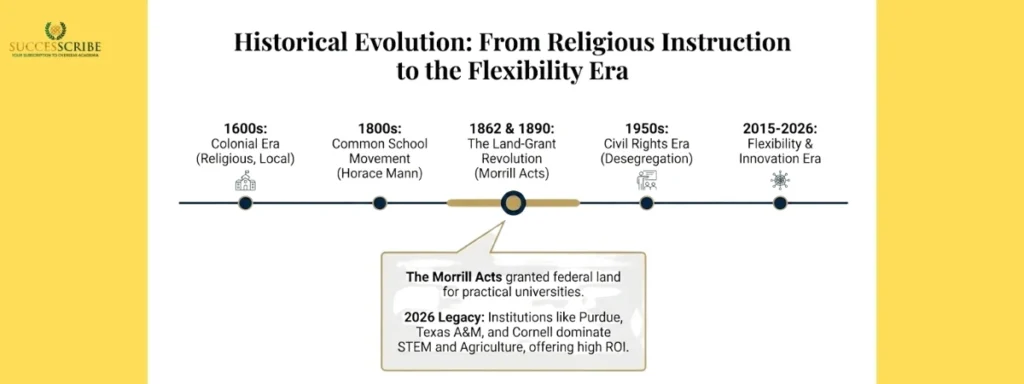
The American education system evolved through centuries of reform, shaped by economic needs, civil rights movements, and shifting social values. To fully understand the education system in USA, it is essential to examine its historical evolution, which has been deeply influenced by social reforms, economic demands, and civil rights movements.
Key Historical Phases
- Colonial Era (1600s–1700s): Education largely religious, informal, and locally controlled.
- Common School Movement (1800s): Led by Horace Mann, promoting free, tax-funded public education.
- Land-Grant Revolution (1862 & 1890): Morrill Acts expanded practical, technical higher education.
- Compulsory Education Era (1852–1918): All states mandated school attendance.
- Civil Rights Era (1950s–1960s): Desegregation and equity-focused funding laws.
- Accountability Era (2001–2015): Standardized testing and performance metrics.
- Flexibility & Innovation Era (2015–2026): State autonomy, digital learning, skill-based education.
The Morrill Acts and the Birth of Practical Education in the USA
A turning point in American education history was the Morrill Land-Grant Acts (1862 & 1890). These laws reshaped higher education by aligning it with national economic needs.
Why This Still Matters in 2026
Land-grant universities today:
- Produce some of the highest STEM graduate employment rates
- Lead in engineering, agriculture, AI, and public research
- Offer better ROI compared to elite private universities
Examples of Leading Land-Grant Universities
- Purdue University
- Texas A&M University
- University of Wisconsin–Madison
- Cornell University
For international students, these institutions provide:
- World-class research exposure
- Strong industry links
- Relatively lower tuition than private Ivy League schools
Structure of the Education System in the USA
The education system in USA is structured across multiple academic levels, ensuring age-appropriate learning pathways from early childhood education to advanced doctoral studies.
| Level | Age Group | Duration |
| Early Childhood Education | 3–5 years | 1–2 years |
| Elementary School | 6–10 years | Grades 1–5 |
| Middle School | 11–13 years | Grades 6–8 |
| High School | 14–18 years | Grades 9–12 |
| Undergraduate Education | 18–22 years | 3–4 years |
| Graduate Education | 22+ years | 1–6 years |
Governance of Education: Federal, State, and Local Roles
Education governance in the USA is rooted in the 10th Amendment, which reserves education authority for the states.
Division of Responsibility
| Authority | Key Role |
| Federal Government | Funding, civil rights enforcement, national data |
| State Governments | Curriculum standards, graduation rules |
| Local School Districts | Daily operations, staffing, budgeting |
The U.S. Department of Education does not prescribe textbooks or exams; instead, it enforces laws like Title IX, IDEA, and ESSA.
Funding Reality Check: Who Really Pays for Education in the USA?
The U.S. education system operates on a three-tier funding model, and understanding this is critical to understanding its strengths and flaws.
| Funding Source | Approx. Share | Key Purpose |
| Federal Government | 8–9% | Equity programs, disability education, low-income support |
| State Governments | 48–50% | Teacher salaries, curriculum standards |
| Local Governments | 42–43% | School infrastructure, facilities, enrichment |
The Property Tax Problem
Local school funding is heavily dependent on property taxes, which means:
- Wealthy districts can spend 2–3× more per student
- Poor districts struggle with outdated infrastructure
- Educational inequality becomes geographically embedded
Even in 2026, this remains one of the most criticized aspects of the U.S. education system.
Structure of the K – 12 Education System
The K – 12 system forms the foundation of American education, offering free public schooling from ages 5 to 18.
| Level | Age | Grades | Focus |
| Preschool | 3–5 | Pre-K | Social & cognitive development |
| Elementary | 5–10 | K–5 | Core literacy & numeracy |
| Middle School | 11–14 | 6–8 | Subject specialization |
| High School | 14–18 | 9–12 | College & career readiness |
Early Childhood Education & the Kindergarten Gap
Although not mandatory, early education is increasingly seen as essential.
Post-2020 Impact
- Over 1 million children skipped kindergarten
- K–12 enrollment fell by 3%
- Learning gaps widened significantly
In 2026, states are investing heavily in early intervention and literacy recovery programs.
High School Education System in USA
High school education in the United States represents a critical phase in a student’s academic journey, serving as the bridge between compulsory schooling and higher education or career pathways. In the U.S., high school typically covers Grades 9 to 12, with students usually aged 14 to 18 years. As of 2026, the United States has over 26,000 public and private high schools, educating more than 15.5 million students nationwide.
The U.S. high school system is known globally for its flexibility, subject choice, extracurricular emphasis, and holistic student development, making it particularly attractive to both domestic and international students. High school education represents a pivotal stage in the education system in USA, bridging compulsory schooling with higher education and workforce readiness.
Structure of High School Education in the USA
High school in the USA is divided into four academic years, each commonly referred to by a specific designation:
| Grade | Common Name | Typical Age |
| Grade 9 | Freshman Year | 14–15 years |
| Grade 10 | Sophomore Year | 15–16 years |
| Grade 11 | Junior Year | 16–17 years |
| Grade 12 | Senior Year | 17–18 years |
Unlike many countries where curricula are centrally controlled, education in the USA is governed at the state and local school district level. This means graduation requirements may vary slightly from state to state, but the overall structure remains consistent nationwide.
Apply to Top European Universities
Make your application simple and stress-free with Successcribe
Get Expert Help NowCurriculum and Subjects Offered in U.S. High Schools
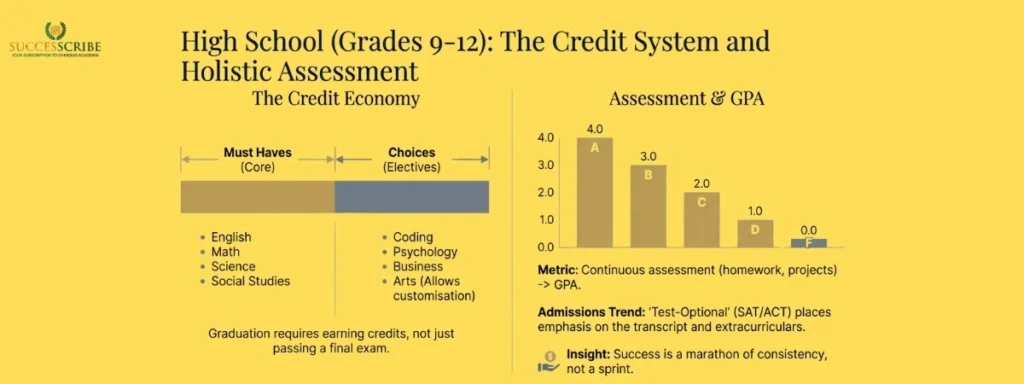
One of the most distinctive features of high school education in the USA is its credit-based system. Students must earn a specific number of credits across required and elective subjects to graduate.
Core Mandatory Subjects
Most U.S. states require students to complete credits in the following areas:
- English Language Arts (4 years)
- Mathematics (3–4 years)
- Science (3 years)
- Social Studies (3 years)
- Physical Education / Health (1–2 years)
Elective Subjects
In addition to core subjects, students can choose from a wide range of electives, allowing them to explore interests and build early specialization. Common Electives include:
- Computer Science & Coding
- Psychology & Sociology
- Business Studies & Entrepreneurship
- Economics & Finance
- Foreign Languages (Spanish, French, German, Mandarin, etc.)
- Visual Arts, Music, Theatre
- Journalism & Media Studies
This flexibility enables students to customize their academic profile, which is highly valued by U.S. colleges and universities.
Assessment and Grading System
High school assessment in the USA is continuous and multi-dimensional rather than exam-centric. Common evaluation methods include:
- Class tests and quizzes
- Homework assignments
- Research projects and presentations
- Mid-term and final exams
- Class participation
| Letter Grade | Percentage Range | GPA Value |
| A | 90–100% | 4.0 |
| B | 80–89% | 3.0 |
| C | 70–79% | 2.0 |
| D | 60–69% | 1.0 |
| F | Below 60% | 0.0 |
Most U.S. universities place strong emphasis on a student’s high school GPA, especially Grades 9–12 performance.
Why GPA Matters
- College admissions
- Scholarships
- Internships
- Graduate school
The emphasis on continuous assessment rewards consistency but increases year-round academic pressure.
While the GPA is the primary metric, university admissions are holistic. Officers weigh extracurricular leadership, personal essays, and standardized tests (SAT/ACT) alongside grades. In 2026, many universities have moved to “Test-Optional” permanently, increasing the weight of the high school transcript.
Types of Higher Education Institutions in the USA
The U.S. higher education landscape includes a wide range of institution types, each catering to different academic, professional, and financial needs.
| Type of Institution | Description | Typical Duration | Examples |
| Community Colleges | Two-year institutions offering associate degrees and certificates | 2 years | Santa Monica College, Houston CC |
| Public Universities | State-funded universities with large student populations | 4 years (UG) | University of California, University of Texas |
| Private Universities | Privately funded, often smaller class sizes | 4 years (UG) | Harvard, Stanford |
| Liberal Arts Colleges | Focus on broad-based education in arts and sciences | 4 years | Amherst College, Williams College |
| Research Universities | Strong emphasis on research and doctoral programs | UG – PhD | MIT, Johns Hopkins |
| For-Profit Institutions | Career-focused, industry-aligned programs | Varies | Limited recognition |
As of 2026, public universities educate nearly 72% of all U.S. college students, making them the backbone of the American higher education system.
Degree Structure in the USA
The U.S. follows a multi-tier degree system that allows students to enter, exit, or progress at multiple stages.
Associate Degree
- Offered primarily by community colleges
- Duration: 2 years
- Common types:
- Associate of Arts (AA)
- Associate of Science (AS)
- Often used as a transfer pathway to a bachelor’s degree
Bachelor’s Degree
- Duration: 4 years
- Most common undergraduate degree globally
- Students typically choose a major after the first or second year
- Popular degrees:
- Bachelor of Science (BS)
- Bachelor of Arts (BA)
Master’s Degree
- Duration: 1–2 years
- Includes academic and professional programs
- Popular programs for international students:
- MS in Computer Science
- MS in Data Science
- MBA
- MS in Engineering
Doctoral Degree (PhD)
- Duration: 4 – 7 years
- Research-intensive programs
- USA produces nearly 40% of the world’s top-ranked research publications
Credit System and Academic Flexibility
The U.S. higher education system operates on a credit-hour system, providing unmatched flexibility.
- 1 credit = 1 hour of classroom instruction per week
- Bachelor’s degree requires 120 – 130 credits
- Master’s degree requires 30 – 60 credits
Students can:
- Change majors
- Take interdisciplinary courses
- Transfer credits between institutions
- Combine majors and minors
This flexibility allows students to align education with evolving career goals, a key reason the U.S. remains a top study destination.
Cost of Higher Education in the USA
The cost of studying in the USA varies by institution type and program.
| Level | Public Universities (USD/year) | Private Universities (USD/year) |
| Bachelor’s | $20,000 – $35,000 | $40,000 – $60,000 |
| Master’s | $22,000 – $45,000 | $35,000 – $70,000 |
| PhD | Mostly funded | Mostly funded |
Despite higher costs, the USA offers extensive scholarships, assistantships, and on-campus employment opportunities.
International Student Success: Pathways, Visas, and Support
Despite high costs, the U.S. remains the world’s premier destination for international students, with Indian student enrollment reaching a historic high of 3.3 lakh (330,000) in the 2025-2026 cycle. The education system in USA continues to attract millions of international students due to its academic reputation, research opportunities, and global career outcomes.
The Visa Journey: F-1, I-20, and SEVIS
For the international student, the process begins after institutional acceptance:
- I-20 Form: The university issues this document, certifying that the student is enrolled in a full-time program and has the financial means to support themselves.
- SEVIS: Students must pay the SEVIS (Student and Exchange Visitor Information System) fee, which allows the U.S. government to track their status.
- F-1 Visa: The standard student visa. It allows students to work up to 20 hours per week on-campus during the semester.
Accreditation: The Global Safeguard
International students must verify an institution’s Accreditation. Unlike other countries, accreditation is performed by independent bodies recognized by the Council for Higher Education Accreditation (CHEA) or the U.S. Department of Education. Degrees from unaccredited “diploma mills” are not recognized by global employers and can invalidate future visa applications.
The Economics of Education: ROI Matters in 2026
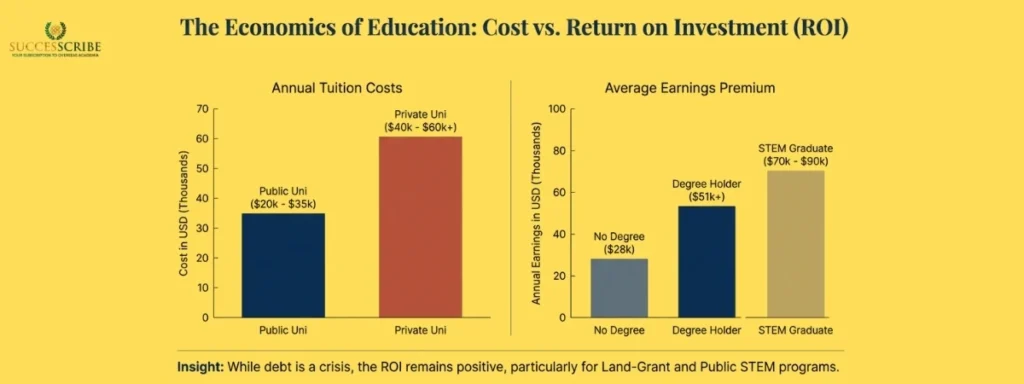
The student loan crisis has fundamentally changed how education is evaluated.
Degree vs No Degree (Average Earnings)
| Category | Average Annual Income |
| Without College Degree | $28,000 |
| With College Degree | $51,000+ |
| STEM Graduates | $70,000–90,000 |
While debt remains high, earning potential still favors graduates, especially in:
- Computer Science
- Engineering
- Healthcare
- Data & AI fields
Conclusion
The American education system in 2026 embodies extraordinary complexity – simultaneously offering unparalleled opportunities and presenting formidable challenges. Its decentralized architecture enables innovation and local responsiveness while perpetuating profound inequities based on geography, race, and economic status.
For domestic students, success requires understanding that the “property tax trap” means educational quality varies dramatically by zip code. Strategic families research districts, consider charter or private options, and advocate for equitable funding reforms. The continuous assessment model demands sustained effort across years rather than final examination cramming – a marathon requiring exceptional organizational skills and stress management. Overall, the education system in USA represents a complex yet powerful academic ecosystem, offering unmatched opportunities alongside persistent challenges related to equity and access.
FAQs
How is the education system in the USA different from other countries?
The U.S. education system is decentralized, meaning there is no single national curriculum or examination system. States and local school districts control curriculum, assessments, and graduation requirements, allowing flexibility, innovation, and subject choice – unlike centralized systems in countries such as India, China, or France.
Who controls education in the United States?
Education in the USA is primarily controlled by state governments and local school districts. The federal government plays a limited role, focusing on funding support, civil rights enforcement, and national data collection through the U.S. Department of Education.
What is the structure of the K–12 education system in the USA?
The K–12 system includes:
Elementary School: Kindergarten to Grade 5
Middle School: Grades 6 to 8
High School: Grades 9 to 12
This system provides free public education for students aged approximately 5 to 18 years.
Are SAT or ACT exams mandatory for U.S. college admissions in 2026?
No. As of 2026, many U.S. universities have adopted test-optional or test-free policies. However, strong SAT/ACT scores can still enhance applications, especially for scholarships and competitive programs.
What types of higher education institutions exist in the USA?
The U.S. offers diverse institution types, including:
1. Community Colleges
2. Public Universities
3. Private Universities
4. Liberal Arts Colleges
5. Research Universities
Each serves different academic, career, and financial needs.
Related Post
Exams required to study in USA
Bank for international students in USA
Profile building bachelors in USA
Commerce courses and colleges in USA