
Over the last decade, data science has emerged as one of the most powerful and high-impact fields globally, driving innovation across industries such as technology, finance, healthcare, retail, manufacturing, and government. The United States of America has consistently remained at the forefront of this transformation, offering world-class data science courses and universities supported by advanced research infrastructure, industry partnerships, and unmatched employment opportunities. Data Science Courses and Universities in USA have become the global benchmark for cutting-edge education, innovation, and career-ready training, making the country the top destination for aspiring data professionals in 2026.
As of 2026, the USA hosts over 4,000 accredited universities, with hundreds of specialized programs in data science, analytics, artificial intelligence, and machine learning. According to the U.S. Bureau of Labor Statistics (BLS), data science-related occupations are projected to grow by 35% between 2022 and 2032, making it one of the fastest-growing career paths in the country.
Key Highlights: Data Science Courses and Universities in USA
- What Is Data Science?
- A “Data Science” Degree Isn’t the Only Path to a Data Career
- Landscape of Data Science in the USA
- Types of Data Science Courses in USA
- Decoding Data Science Programs: Finding Your Fit
- You Can Start Learning from a Top University for Free (But Mastery Costs)
- Admission Requirements for Data Science in USA
- The STEM Advantage: Your 3-Year Career Launchpad
- Data Science Job Market is Growing Even Faster Than You Think
- Portfolio & GitHub Importance for Data Science Students
- Conclusion
- FAQs
Want to Study in Europe?
Start your journey with Successcribe’s free expert guidance
Book a Free Session NowWhat Is Data Science?
Data Science is an interdisciplinary field that combines:
- Statistics and Mathematics
- Computer Science and Programming
- Machine Learning and Artificial Intelligence
- Data Visualization and Business Intelligence
The primary objective of data science is to extract meaningful insights from structured and unstructured data to support decision-making, predictive modeling, and automation.
Exposure to real-time data tools is a core advantage of studying data science in USA.
Core Components of Data Science
The foundation of Data Science in USA rests on statistics, coding, machine learning, and domain understanding. These elements work together to create industry-ready professionals.
| Component | Description |
| Statistics | Probability, hypothesis testing, regression analysis |
| Programming | Python, R, SQL, Java, Scala |
| Machine Learning | Supervised & unsupervised learning, deep learning |
| Big Data | Hadoop, Spark, cloud computing |
| Data Visualization | Tableau, Power BI, Matplotlib |
| Domain Knowledge | Finance, healthcare, marketing, engineering |
In the USA, data science programs are designed to be industry-aligned, ensuring graduates are job-ready upon completion.
A “Data Science” Degree Isn’t the Only Path to a Data Career
Many universities offer a flagship “Master of Science in Data Science,” but fixating on this title is a critical mistake. The field is highly interdisciplinary, and top programs are often specialized, coming with a variety of different names. Your task, therefore, is to act like a data scientist in your own university search. Look beyond the label and analyze the underlying data: the curriculum, the faculty’s research, and the alumni outcomes.
Top universities offer a wide range of specialized master’s programs that can lead to an exceptional data career, including:
- Master of Science in Business Analytics
- Master of Information and Data Science (MIDS)
- Master of Science in Computational Data Science
- Master of Science in Health Data Science
- Master of Applied Data Science
Data Science Courses and Universities in USA offer diverse degree titles beyond traditional data science programs, allowing students to specialize in analytics, AI, health data, or business intelligence.
This diversity is a huge advantage. It allows you to find a program that truly aligns with your specific career goals, whether you aim to work in finance, healthcare, AI research, or business strategy. Don’t limit your search; broaden your perspective.
Landscape of Data Science in the USA
The data science sector has evolved rapidly. By 2026, the global data science platform market is projected to reach $322.9 billion, with North America commanding nearly 35% of this share. The “Data Science in USA” narrative is no longer just about Silicon Valley; it has spread into biopharma in Massachusetts, fintech in New York, and logistics in the Midwest.
Market Facts and Figures
- Total Jobs: The U.S. Bureau of Labor Statistics (BLS) projects 328,300 data science roles by 2034, representing a 34% growth rate – over eight times the national average for other occupations.
- Market Growth: The high-performance data analytics market is growing at a CAGR of 21.12%, hitting a valuation of $152.6 billion in 2026.
- The AI Impact: 72% of AI/ML teams now rely on data science specialists to clean and label data for Large Language Models (LLMs), a shift that has created a new sub-discipline: MLOps (Machine Learning Operations).
The rapid expansion of Data Science Courses and Universities in USA reflects the country’s growing reliance on data across industries such as healthcare, finance, technology, and public policy.
Types of Data Science Courses in USA
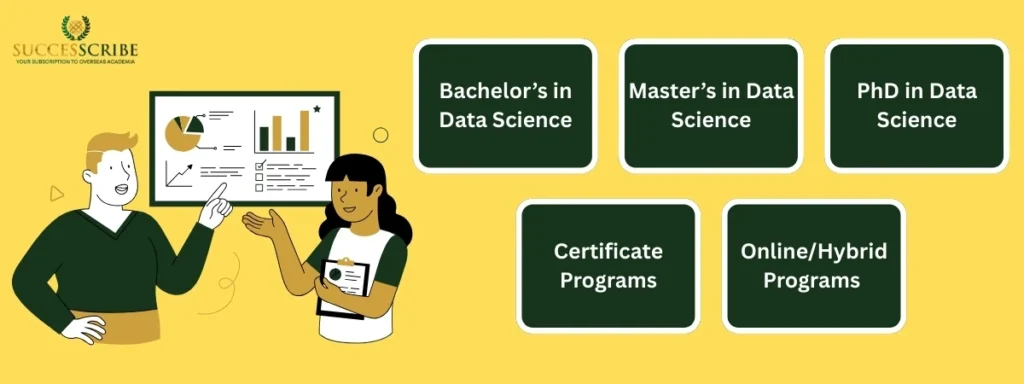
Data science education in the USA is offered at multiple academic levels.
| Course Type | Duration | Who Should Apply |
| Bachelor’s in Data Science | 4 years | After high school |
| Master’s in Data Science | 1.5 – 2 years | Graduates & professionals |
| PhD in Data Science | 4 – 6 years | Research aspirants |
| Certificate Programs | 3–12 months | Skill enhancement |
| Online/Hybrid Programs | Flexible | Working Professionals |
Decoding Data Science Programs: Finding Your Fit
Many universities design programs around real business use cases, strengthening the value of data science in USA. Data science education in the United States is not a one-size-fits-all proposition. It is structured across distinct academic levels – Bachelor’s, Master’s, and PhD, each designed with a specific purpose, level of depth, and career outcome in mind. Understanding these distinctions is crucial for selecting a program that aligns perfectly with your academic background and professional aspirations. According to hiring reports, roles associated with data science in USA experience lower unemployment rates than many other tech fields.
1. Undergraduate (Bachelor’s) Programs
A Bachelor’s degree in data science serves as a foundational program, equipping students with the core competencies necessary to enter the field. These programs are interdisciplinary by nature, building a strong base by combining coursework from computer science, statistics, and mathematics. They are ideal for students beginning their higher education journey and aiming for entry-level analyst or junior data scientist roles.
Popular undergraduate degree
- Bachelor of Science in Data Science
- BS in Statistics and Data Science
- B.A. in Computer Science and Data Science.
Average tuition: $25,000 – $55,000 per year
Core Subjects
- Calculus & Linear Algebra
- Probability & Statistics
- Python & R Programming
- Data Structures
- Database Systems
- Machine Learning Basics
2. Graduate (Master’s) Programs
Master’s programs represent the most popular and direct pathway for specialized training in data science. These programs are designed for students who have completed a bachelor’s degree, typically in a quantitative field, and wish to gain advanced, practical skills for high-level professional roles. The U.S. offers a variety of Master’s degrees tailored to different career objectives.
Average tuition: $35,000 – $75,000 total
- Master of Science in Data Science (MS)
This is the quintessential data science degree, with a curriculum that emphasizes a strong foundation in computer science, statistics, and applied mathematics. It often includes hands-on experience with real-world datasets to prepare students for technical roles.
- Master of Information and Data Science (MIDS)
Often delivered in a flexible online format, the MIDS is designed for working professionals who want to gain expertise in data analysis and strategic decision-making without interrupting their careers.
- Master of Science in Business Analytics
This degree is targeted at business-minded professionals and focuses on applying statistical and analytical tools to solve complex business challenges, bridging the gap between data science and corporate strategy.
- Master of Applied Data Science
This is a practical, hands-on degree designed to prepare students to apply data science techniques directly to solve real-world problems, with a strong emphasis on implementation and project-based learning.
3. Doctoral (PhD) Programs
PhD programs stand at the pinnacle of data science education and are intended for individuals passionate about advanced, independent research and contributing new knowledge to the field. These programs are deeply interdisciplinary and require students to engage with the theoretical foundations of data science, develop novel algorithms, and publish original research. Graduates are prepared for top-tier roles in academia and industrial research labs. PhD Titles for Data Science are:
- PhD in Data Science
- PhD in Statistics and Data Science.
You Can Start Learning from a Top University for Free (But Mastery Costs)
Here is one of the most surprising truths about data science education: it can be both completely free and incredibly expensive, often from the same world-class institution. Take Harvard University, for example. It offers a variety of free online data science courses, allowing anyone with an internet connection to start learning foundational skills through courses like “Data Science: R Basics” and “Data Science: Wrangling.”
Students pursuing data science in USA gain exposure to real-world datasets and problem-solving environments. This stands in stark contrast to the cost of a formal degree. The annual tuition for a Master’s program in Data Science in the USA can range from approximately $45,000 to over $91,000. Treat these free courses as a no-risk diagnostic. They are your opportunity to test your aptitude and passion for the field’s rigorous foundations before you commit to a six-figure investment. Completing one is a powerful data point for your Statement of Purpose and a crucial step in your due diligence.

Top Universities for Data Science in USA
| University | Rank | Bachelors Programmes | Master’s Programmes |
| Massachusetts Institute of Technology (MIT) | #1 | B.S. in Business Analytics | MS in Business Analytics |
| Stanford University | #3 | B.S. in Data Science | MS in Statistics: Data Science |
| Harvard University | #5 | MS in Data Science; MSc in Health Data Science | |
| California Institute of Technology (Caltech) | #10 | B.A. in Information and Data Science | |
| University of Pennsylvania | #15 | MSE in Data Science | |
| Cornell University | #16 | MS in Data Science; M.Sc. Applied Information Science | |
| University of California, Berkeley (UCB) | #17 | B.A. in Data Science | Master of Analytics; Master of Information and Data Science (MIDS) |
| Yale University | #21 | B.S. in Statistics and Data Science | MS in Statistics and Data Science |
| University of Washington | #81 | MS in Data Science | |
| Carnegie Mellon University (CMU) | #52 | B.S. in Statistics and Data Science | MS in Computational Data Science; MS in Data Analytics |
| New York University (NYU) | #55 | B.A. in Computer Science and Data Science | MS in Data Science |
| University of California, San Diego (UCSD) | #66 | MS in Data Science |
Note: While some of these universities may not have a specifically named “BS in Data Science” mentioned in the sources, they are frequently cited as top institutions for the subject area across all levels of study. Choosing a level of study in Data Science is like building a skyscraper: a Bachelors degree provides the solid foundation and structural frame; a Master’s adds the specialised systems and high-end finishes for professional use; and a PhD is the laboratory at the top where new architectural methods are invented to build even higher in the future.
Apply to Top European Universities
Make your application simple and stress-free with Successcribe
Get Expert Help NowAdmission Requirements for Data Science in USA
Applying to a Data Science programme in the USA is a highly structured process that varies significantly by the level of study. With a projected 35% to 36% growth in Data Science jobs between 2021-22 and 2031-32, these programmes have become increasingly competitive.
Core Admission Requirements by Degree Level
Each level of study has unique prerequisites, ranging from foundational high school subjects to advanced research potential for doctoral candidates.
| Requirement | Bachelor’s Degree | Master’s Degree (MS) | PhD (Doctoral) |
| Minimum GPA | 3.0 or higher | 3.0 (or 80%) | 3.0 or higher |
| Standardised Tests | SAT or ACT | GRE (sometimes waived) | GRE (often optional/waived) |
| Academic Background | High School Diploma | Degree in CS, Maths, Stats, and Economics | A master’s in a related field is preferred |
| Key Subjects | Math, Physics, and Chemistry | Multivariate Calculus, Algebra, Statistics | Advanced Researched Methadology |
| Experience | Usually Required | 2–3 years (advantageous/required) | Demonstrated research & publications |
English Language Proficiency Benchmarks
International students must prove their English proficiency. Scores vary by the prestige of the institution and the level of the programme.
| Test Type | Undergraduate Level | Postgraduate Level (MS/ PhD) |
| IELTS (Academic) | 6.5 – 7.5 | 7.0 or higher |
| TOEFL iBT | 90 – 102 | 80 – 100+ |
| Duolingo (DET) | 115 – 130 | 120 – 135 |
Essential Application Documents Checklist
Regardless of the degree, certain documents are mandatory for both university admission and student visa processing:
- Official Transcripts: Complete academic records from all previous institutions.
- Statement of Purpose (SOP): An essay detailing motivations, career goals, and interest in the specific programme.
- Letters of Recommendation (LOR): Typically 2 to 3 letters from teachers, professors, or employers who can attest to your capabilities.
- Resume/CV: Highlighting academic projects, internships, or professional experience.
- Financial Documentation: Proof of funding for tuition and living expenses, which is a requirement for visa processing.
Critical Facts and Figures for Applicants
Test Scores:
| SAT Math Score | 760 |
| GRE scores | 325+ |
Tuition Costs:
| MS Programmes | $12,264 – 91,250 per year |
| Bachelor’s degrees | 45,096 – $67,250 per year |
Acceptance Rates: Top-tier universities like MIT and Harvard have extremely selective acceptance rates, often between 3% and 5%
Preparing your application is like training for a marathon: while the final race is what matters, your success is determined by the GPA base you’ve built, the standardised test sprints you’ve practiced, and the documentary endurance you show in getting every transcript and letter across the finish line. Research and innovation remain key pillars supporting the advancement of data science in USA.
The STEM Advantage: Your 3-Year Career Launchpad
Employment growth, rising investment, and enterprise-level adoption continue to reinforce the long-term relevance of Data Science Courses and Universities in USA.
One of the most significant advantages of pursuing a Data Science degree in the United States is its classification as a STEM (Science, Technology, Engineering, and Mathematics) designated programme. This status is a game-changer for international students, offering a direct pathway to extended professional experience in the world’s leading tech ecosystem.
| Feature | Standard OPT | STEM OPT Extension | Total Work Authorisation |
| Duration | 12 Months | + 24 Months | 36 Months (3 Years) |
| Eligibility | All graduates | STEM-designated degree holders | Data Science graduates |
| Key Benefit | Initial work experience | Extended tenure & H-1B opportunities | Long-term career stability |
Quick Facts for International Applicants
- University Availability: Over 100+ prestigious US universities offer Data Science as a STEM-recognised course.
- Visa Support: Leading consultants and university student services provide dedicated support for F-1 visa preparation and OPT filing to ensure a stress-free transition from campus to the corporate world.
The STEM designation is effectively a “professional bridge”: while a standard degree gets you to the edge of the water, the 24-month extension provides the sturdy, long-term structure needed to walk all the way across into a permanent career in the American tech industry.
Important Note for International Students
While the majority of data science programs are STEM-designated, program titles alone do not guarantee STEM status. Students should:
- Confirm the CIP code
- Check OPT eligibility before accepting offers
- Ensure coursework aligns with STEM requirements
Data Science Job Market is Growing Even Faster Than You Think
The demand for skilled professionals continues to grow as data science in USA becomes central to business strategy and automation. While you already know data science is a hot field, the official projections are staggering. According to the U.S. Bureau of Labor Statistics (BLS), employment for data scientists is projected to grow by 35% from 2022 to 2032. The sustained expansion of the data economy continues to drive demand for graduates of Data Science Courses and Universities in USA.
This growth rate is significantly faster than the average for all other occupations, signaling an incredible and sustained demand for qualified graduates. This isn’t a short-term trend; it’s a fundamental economic shift. This explosive demand translates into a wide array of high-value career opportunities for those with the right skills.
Some of the most sought-after roles for graduates include:
- Data Scientist
- Machine Learning Engineer
- Data Analyst
- Business Intelligence (BI) Developer
- AI Engineer
- Research Scientist
Job Prospects and Salaries in the US
According to industry reports, roles linked to data science in USA consistently rank among the top 10 highest-paying technology jobs. The ultimate return on your educational investment is a successful and rewarding career. In the United States, the demand for data science professionals is exceptionally high. The U.S. Bureau of Labor Statistics projects a 35% increase in jobs for data scientists between 2022 and 2032, reflecting the critical need for data-driven decision-making across all sectors of the economy. Graduates with a U.S. degree are well-positioned to step into a wide variety of high-impact, high-paying roles.
Common Data Science Career Paths and Average Annual Salaries
| Job Role | Average Annual Salary (USD) |
| Machine Learning Engineer | $166,401 |
| Data Scientist | $160,586 |
| Robotics Research Scientist | $156,000 |
| Data Visualization Developer | $133,600 |
| Big Data Solutions Architect | $132,887 |
| Data Mining Engineer | $127,500 |
| AI Researcher | $113,102 |
| Business Intelligence Analyst | $91,318 |
Portfolio & GitHub Importance for Data Science Students

According to industry surveys, roles related to data science in USA consistently rank among the top 10 highest-paying tech careers. In the United States, academic knowledge alone is not sufficient to secure roles in data science. Employers increasingly evaluate candidates based on their practical skills, problem-solving ability, and real-world project experience. As a result, a strong data science portfolio and an active GitHub profile have become essential for students pursuing data science in USA. In the US job market, the value of Data Science Courses and Universities in USA is fully realised when academic learning is supported by strong project portfolios and public code repositories.
Why a Portfolio Matters in the US Job Market
- A well-structured portfolio allows employers to:
- Assess hands-on experience beyond coursework
- Understand how candidates approach real data problems
- Evaluate programming, analytical, and visualization skills
According to hiring trends reported by NACE and leading US tech recruiters, candidates with project-based portfolios are significantly more likely to receive interview calls than those relying solely on academic credentials.
Role of GitHub in Data Science Careers
GitHub serves as a public technical resume for data science students. US employers frequently review GitHub repositories to assess:
- Code quality and documentation
- Use of industry-standard tools (Python, SQL, ML libraries)
- Version control and collaboration skills
Active GitHub profiles demonstrate technical maturity and professional readiness, especially for roles such as Data Scientist, Machine Learning Engineer, and Data Analyst.
What Should a Data Science Portfolio Include?
Many global companies partner with institutions to enhance applied training in data science in USA.
| Portfolio Element | Purpose |
| End-to-End Project | Showcase data cleaning, modeling, and insights |
| Machine Learning Models | Demonstrate predictive and analytical ability |
| Data Visualization | Highlight storytelling and business insights |
| Capstone or Research Work | Reflect academic depth and applied learning |
Projects based on real-world datasets – such as customer behavior analysis, healthcare analytics, or financial forecasting – are particularly valued in the US job market.
Conclusion
The data is clear: a U.S. data science degree is not an expense, but a strategic investment with a projected 35% growth in demand and entry into the world’s most dynamic tech ecosystem. As this topic has outlined, the U.S. stands as the world’s premier destination for data science, distinguished by its cutting-edge programs, elite universities, and direct pipeline to a thriving global industry. From understanding the strategic advantages and diverse program options to navigating the application process and planning your investment, a well-prepared approach is key to success. This guide has provided the playbook; your mission is to execute the strategy. The path is challenging, but for those with the ambition to master the language of data, the endeavor is immensely rewarding. Taken together, Data Science Courses and Universities in USA represent a complete ecosystem – education, industry, research, and career progression – built for the future of data-driven work. Due to continuous innovation, data science in USA remains relevant even as technology trends evolve.
FAQs
Is Data Science future-proof in the USA?
Yes. With AI, automation, and data-driven decision-making accelerating across industries, data science remains one of the most future-proof careers in the USA well beyond 2035.
Is Data Science better than Business Analytics in the USA?
Both are valuable, but:
1. Data Science is more technical and AI-focused
2. Business Analytics is strategy and decision-oriented
Your choice should depend on career goals and technical aptitude.
Is an online Data Science degree from the USA valuable?
Yes, if it is from a reputed, accredited university. Programs like Berkeley MIDS and Harvard online certifications are well respected. However, online degrees may not always qualify for OPT.
What are the highest-paying Data Science jobs in the USA?
Top data science roles and average salaries:
1. Machine Learning Engineer – $166,000
2. Data Scientist – $160,000
3. AI Engineer – $150,000+
4. Big Data Architect – $132,000
5. BI Analyst – $91,000
Salaries vary based on location, experience, and industry.
Is the USA the best country to study Data Science in 2026?
Yes, the USA remains the global leader in data science education in 2026. With over 4,000 accredited universities, strong industry-academia collaboration, and a 35% projected job growth for data scientists (U.S. BLS), the USA offers unmatched exposure, research infrastructure, and career opportunities.
Related Post
SOP for MS in Computer Science in USA
Scholarships for bachelors in USA
MBA in business analytics in USA
Masters in Petroleum Engineering in USA