
The United States has long been one of the most preferred destinations for students pursuing commerce, business, and management-related education. With a strong economy, globally ranked universities, industry-oriented curricula, and excellent post-study career opportunities, the USA offers unmatched exposure in the field of commerce.
Unlike many countries where “commerce” is treated as a single stream, the USA offers highly specialized commerce-related programs under business, finance, accounting, economics, analytics, and management disciplines. These programs are designed to align closely with real-world business practices, technological advancements, and global market demands. Commerce Courses and Colleges in USA offer globally recognized education, industry-driven curricula, and excellent career exposure across finance, business, and management disciplines.
Key Highlights: Commerce Courses and Colleges in USA
- What is Commerce Education in the USA?
- Understanding Commerce Degrees in the American System
- Top Commerce Majors & Specializations in the USA
- Top Commerce Colleges & Universities in the USA
- The Admission Process for Commerce Courses in USA
- Course Curriculum for Commerce in USA
- Cost of Studying Commerce in the USA
- Career Opportunities After Commerce Courses in USA
- How to Choose the Best Commerce Course & College in the USA
- Conclusion
- FAQs
Want to Study in Europe?
Start your journey with Successcribe’s free expert guidance
Book a Free Session NowWhat is Commerce Education in the USA?
In the US education system, commerce is not usually offered as a standalone degree named “Bachelor of Commerce (B.Com)” as in India. Instead, commerce education is delivered through:
- Business Administration
- Accounting
- Finance
- Economics
- Marketing
- Management
- Business Analytics
- International Business
These programs focus on:
- Financial literacy and reporting
- Business strategy and decision-making
- Market analysis and economics
- Corporate governance and ethics
- Data-driven business solutions
Commerce Courses and Colleges in USA deliver commerce education through specialized business, finance, accounting, economics, and analytics programs rather than a single B.Com degree.
Commerce vs Business vs Economics (USA Context)
| Aspect | Commerce | Business | Economics |
| Focus | Trade, finance, accounting | Operations, management, leadership | Markets, policies, theory |
| Orientation | Practical + professional | Managerial + applied | Analytical + research |
| Career Scope | Accounting, finance, consulting | Management, marketing, startups | Policy, research, analytics |
Understanding Commerce Degrees in the American System
In the United States, commerce education is structured across multiple degree levels, each designed to serve different career stages and professional objectives. Commerce Courses and Colleges in USA provide multiple degree pathways – from associate and bachelor’s programs to master’s and PhD levels – catering to different academic and career stages. Understanding these distinctions is crucial for international students and domestic applicants alike.
1. Associate Degree in Business (2 Years)
The Associate degree represents the entry point into commerce education, typically requiring two years of full-time study. Community colleges and technical institutes across the country offer these programs, providing foundational knowledge in business principles, basic accounting, marketing fundamentals, and management concepts.
- Duration: 2 years
- Offered by: Community colleges
- Popular fields: Business Administration, Accounting, Economics
- Purpose: Foundation education or transfer to a bachelor’s degree
Average Tuition: USD 8,000 – 15,000 per year
2. Bachelor’s Degree (Undergraduate)
four-year programs provide comprehensive education across all major business disciplines while allowing students to develop specializations in their areas of interest.
The structure typically includes two years of general education requirements covering mathematics, sciences, humanities, and communication skills, followed by two years of concentrated business coursework. During their junior and senior years, students declare specializations such as accounting, finance, marketing, supply chain management, or international business.
Duration: 4 years
Eligibility:
- 12 years of schooling
- Commerce, math, or economics background preferred
- SAT/ACT (optional in many universities)
The most common undergraduate commerce-related degrees include:
- Bachelor of Business Administration (BBA)
- Bachelor of Science (BS) in Accounting
- BS in Finance
- BS in Economics
- BS in Business Analytics
3. Master’s Degree (Postgraduate)
Master’s degrees in commerce include several variants, each serving distinct purposes.
Highly popular among Indian and international students. The Master of Business Administration (MBA) remains the most recognized and versatile option, designed for students with prior work experience seeking to advance into leadership positions. The Master of Science in Business (MS) targets students with quantitative backgrounds seeking specialized expertise in areas like finance, marketing analytics, or business analytics.
Common Master’s Programs:
- MBA (Master of Business Administration)
- MS in Finance
- MS in Accounting
- MS in Business Analytics
- MS in Economics
- MS in International Business
Duration: 1 – 2 years
Entry Requirements:
- Bachelor’s degree
- GMAT/GRE (waived by many universities)
- English proficiency
4. Doctoral Programs (4-6 Years)
Doctor of Philosophy (PhD) programs in business prepare students for research and academic careers. These intensive programs combine advanced coursework with original research, culminating in a dissertation. PhD programs typically provide full funding through teaching assistantships, research positions, or fellowships, making them financially viable despite their length.
- Ideal for academic, research, and policy-oriented careers
- Duration: 4 – 6 years
- Often funded with tuition waivers and stipends
- Professional Certifications (Highly Valued)
- Professional Certifications (Highly Valued)
| Certification | Full Form | Global Value |
| CPA | Certified Public Accountant | Very High |
| CFA | Chartered Financial Analyst | Very High |
| CMA | Certified Management Accountant | High |
| CFP | Certified Financial Planner | High |
Top Commerce Majors & Specializations in the USA
Choosing a specialization is a critical step in tailoring a commerce education to specific career goals. U.S. universities offer a wide array of majors that allow students to develop deep expertise in a particular area of the commercial world. Commerce Courses and Colleges in USA offer in-demand specializations such as Accounting, Finance, Business Analytics, Economics, Marketing, and International Business aligned with global markets. This section explores some of the most popular commerce specializations and the opportunities they present.
1. Accounting
Accounting is a core commerce subject focused on managing and reporting a company’s financial accounts. Programs in this field prepare students for roles in corporate accounting, auditing, and financial consulting.
- Accounting
- Financial accounting
- Auditing
- Taxation
- Forensic accounting
Example Degrees: BBA Accounting, Bachelor of Commerce of Accounting, BS in Accountancy, Master of Accountancy.
2. Finance
Finance programs cover essential topics such as financial management, investments, and investment banking. This specialization is ideal for students interested in corporate finance, asset management, and financial markets.
- Corporate finance
- Investment banking
- Financial modeling
- Risk management
Example Degrees: BBA Finance, Bachelor of Commerce in Finance, BS in Finance, MS in Finance.
3. International Business
As a booming field, international business focuses on the dynamics of expanding business operations across the globe. Students learn about cross-cultural management, global marketing, and international trade policies.
- Example Degrees: Bachelor of Science in International Business, BA in Global Business.
4. Entrepreneurship
Entrepreneurship programs are designed for aspiring business owners and innovators. The curriculum covers business planning, innovation strategies, and the skills needed to launch and manage ventures in a global environment.
- Example Degrees: Bachelor of Entrepreneurship, BBA Entrepreneurship.
5. Supply Chain & Logistics
Supply Chain Management is a critical function in the modern global economy. This specialization focuses on the logistics, procurement, and distribution processes that move goods and services from supplier to consumer.
- Example Degrees: Bachelors in Supply Chain Management.
6. Economics
Economics programs provide a strong analytical foundation, covering topics such as economic research, market analysis, and public policy. Graduates are prepared for roles in finance, government, and consulting.
- Example Degrees: Bachelor of Commerce in Economics, Bachelor’s in Economics.
7. Marketing
Marketing is a key component of any successful business enterprise. These programs explore consumer behavior, brand management, digital marketing, and strategic communication.
- Example Degrees: BS in Marketing, MS in Marketing.
Choosing the right specialization is a crucial step in charting a career path; the next is successfully navigating the admission process to secure a place in one of these competitive programs.
Top Commerce Colleges & Universities in the USA
The United States is home to a vast number of world-renowned universities offering exceptional programs in commerce and business studies. Commerce Courses and Colleges in USA include prestigious public and private universities recognized worldwide for business innovation, research, and graduate employability.
| University Location | Location | University Type |
| Harvard University | Cambridge, MA | Private |
| Stanford University | Stanford, CA | Private |
| Massachusetts Institute of Technology (MIT) | Cambridge, MA | Private |
| University of Pennsylvania | Philadelphia, PA | Private |
| University of California, Berkeley | Berkeley, CA | Public |
| University of Michigan | Ann Arbor, MI | Public |
| New York University (NYU) | New York, NY | Private |
| Columbia University | New York, NY | Private |
| University of Chicago | Chicago, IL | Private |
| Yale University | New Haven, CT | Private |
| Texas A&M University | College Station, TX | Public |
| Arizona State University | Tempe, AZ | Public |
| University of Virginia | Charlottesville, VA | Public |
| University of South Florida | Tampa, FL | Public |
| Pace University | New York, NY | Private |
| Northeastern University | Boston, MA | Private |
Apply to Top European Universities
Make your application simple and stress-free with Successcribe
Get Expert Help NowThe Admission Process for Commerce Courses in USA
Admission to top programs is highly competitive. The process is holistic, evaluating multiple dimensions.
Undergraduate Admission Components:
- Academic Record (40-50% Weight): High school GPA, rigor of curriculum (AP/IB courses). Top schools often report a median GPA above 3.8 (unweighted).
- Standardized Tests: A shifting landscape. For Fall 2026 intake:
- Test-Optional: Many schools remain test-optional (e.g., UChicago, Wharton? – check yearly policy).
- Test-Flexible: Some require SAT/ACT but allow substitution (e.g., AP scores).
- Required: MIT, Georgetown, most public universities (e.g., UT Austin, UNC) require scores.
- Extracurriculars & Leadership: Quality over quantity. Business-related initiatives (starting a venture, DECA, FBLA) are valued.
- Essays & Interviews: Demonstrate passion, self-awareness, and “fit” with the program’s culture.
- Letters of Recommendation: Typically from teachers and a counselor.
Graduate (MBA/Masters) Admission Components:
- Academic Credentials: Undergraduate GPA from an accredited institution.
- Standardized Tests: GMAT Focus Edition or GRE. Median GMAT scores for top 20 programs range from 685 to 740. Many specialized master’s programs are waiving tests for high-GPA applicants.
- Professional Experience: MBA programs expect 3-8 years. Specialized master’s may accept pre-experience candidates.
- Statement of Purpose / Essays: Career goals, “why this program,” and personal narrative.
- Letters of Recommendation: Preferably from current supervisors who can comment on professional impact.
- Interview: By invitation, assessing communication skills and maturity.
English Language Proficiency
- Accepted English language tests include IELTS, TOEFL, and the Duolingo English Test.
- Typical minimum score ranges required by universities are:
| IELTS | 6.0 – 7.0 |
| TOEFL | 80 – 100 |
Required Application Documents
- Statement of Purpose (SOP)
- Letters of Recommendation (LOR)
- Academic transcripts
- CV/Resume
- Portfolio (if applicable)
- Proof of financial support
- A copy of a valid Passport
Meeting these requirements is the first step toward securing admission and planning for the financial aspects of studying in the USA.
Course Curriculum for Commerce in USA
The commerce curriculum in the USA is designed to provide students with a strong theoretical foundation, practical business exposure, and industry-relevant skills. Unlike rigid course structures, US universities offer flexible and customizable curricula, allowing students to tailor their commerce education based on career goals, market demand, and personal interests.
Core Subjects (Common Across Most Commerce Programs)
In the initial phase of undergraduate or postgraduate commerce programs, students study core subjects that build fundamental business and financial knowledge:
- Financial Accounting
- Managerial Accounting
- Microeconomics and Macroeconomics
- Business Mathematics and Statistics
- Principles of Management
- Business Communication
- Corporate Finance
- Business Ethics and Corporate Governance
These subjects help students understand how businesses operate, make financial decisions, and respond to economic changes.
Specialization-Specific Subjects
As students progress, they choose a major or specialization, allowing deeper expertise in a specific commerce field.
| Specialization | Key Subjects Covered |
| Accounting | Auditing, Taxation, Financial Reporting, Forensic Accounting |
| Finance | Investment Analysis, Financial Modeling, Risk Management, Derivatives |
| Marketing | Consumer Behavior, Digital Marketing, Brand Strategy, Market Research |
| Business Analytics | Data Visualization, Business Intelligence, Predictive Analytics |
| International Business | Global Trade, International Finance, Cross-Cultural Management |
| Economics | Econometrics, Public Policy, Development Economics |
STEM-Designated Commerce Programs
Many commerce-related programs such as Business Analytics, Finance, and Economics are STEM-designated, offering international students:
- Quantitative and analytical coursework
- Advanced data-driven curriculum
- Up to 36 months of OPT (12 + 24 months extension)
Cost of Studying Commerce in the USA
Pursuing higher education in the United States represents a significant financial investment. For international students, it is crucial to understand the associated costs and explore potential funding opportunities to plan effectively.

Tuition Fees
Tuition fees are the largest component of educational expenses and vary significantly between public and private universities.
| Public Universities | Annual tuition fees typically range from $10,000 to $30,000 |
| Private Universities | Annual tuition fees are generally higher, ranging from $25,000 to $80,000 |
Living Costs
In addition to tuition, students must budget for living expenses, which include housing, food, transportation, health insurance, and study materials. The estimated monthly cost of living for an international student is between $700 and $1,000. This amount can fluctuate depending on the city and the student’s lifestyle.
Career Opportunities After Commerce Courses in USA
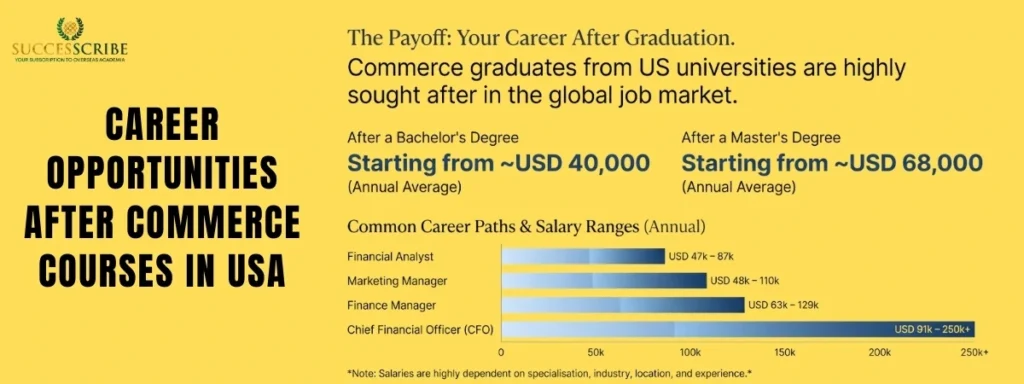
Graduates of commerce-related courses in the USA benefit from strong career prospects across multiple industries such as finance, accounting, consulting, technology, marketing, healthcare, and international trade. With the US being home to many Fortune 500 companies and global financial institutions, commerce graduates are in high demand for their analytical, managerial, and financial expertise.
Popular Job Roles & Average Salaries
Commerce Courses and Colleges in USA prepare graduates for high-growth roles across finance, consulting, analytics, marketing, and global business operations.
| Job Role | Average Annual Salary (USD) |
| Accountant | 60,000 – 85,000 |
| Financial Analyst | 70,000 – 100,000 |
| Business Analyst | 75,000 – 110,000 |
| Management Consultant | 85,000 – 125,000 |
| Marketing Manager | 70,000 – 105,000 |
| Investment Analyst | 80,000 – 120,000 |
| Supply Chain Analyst | 70,000 – 95,000 |
| Risk & Compliance Analyst | 75,000 – 110,000 |
High-Growth Commerce Careers in the USA
The US job market increasingly favors commerce professionals with analytical and digital skills. Some of the fastest-growing roles include:
- Business Analytics & Data-driven roles
- Financial Risk & Compliance Analysts
- ESG (Environmental, Social & Governance) Specialists
- FinTech & Digital Finance Professionals
- Supply Chain & Operations Analysts
Many of these roles are aligned with STEM-designated programs, offering extended work opportunities for international students.
Top Industries Hiring Commerce Graduates
- Banking & Financial Services
- Consulting & Advisory Firms
- Technology & E-commerce Companies
- Healthcare Management
- Retail & FMCG
- Logistics & Supply Chain
- Government & Policy Institutions
How to Choose the Best Commerce Course & College in the USA

Choosing the right commerce course and college in the USA is a critical decision that directly impacts your career growth, return on investment, and long-term opportunities, especially for international students. With hundreds of universities offering commerce-related programs, a structured and informed approach is essential.
1. Identify the Right Commerce Specialization
The first step is to clearly understand which area of commerce aligns with your career goals. The USA offers highly specialized programs rather than a general “commerce” degree.
| Career Goal | Recommended Specialization |
| Accounting & Auditing | Accounting, Professional Accounting |
| Finance & Investment | Finance, Financial Engineering |
| Business Strategy & Consulting | Business Administration, MBA |
| Data-driven Business Roles | Business Analytics (STEM) |
| Global Trade & Management | International Business |
| Policy & Research | Economics |
Choosing the right specialization ensures better employability and focused skill development.
2. Check University Accreditation & Reputation
Always select universities that are regionally accredited in the USA. For commerce and business programs, AACSB accreditation is a strong quality indicator.
Why AACSB matters:
- Only 6% of business schools globally hold AACSB accreditation
- Preferred by global employers
- Higher academic and industry standards
Reputation should be evaluated using program-specific rankings, not just overall university rank.
3. Evaluate Curriculum & Industry Relevance
A strong commerce program should offer:
- Updated curriculum aligned with current industry needs
- Practical learning (case studies, live projects, internships)
- Technology integration (data analytics, financial software)
Look for programs that include:
- Capstone projects
- Internship or co-op options
- Industry partnerships
This ensures real-world readiness, not just theoretical learning.
4. Prefer STEM-Designated Commerce Programs
In 2026, choosing a STEM-designated commerce program is highly beneficial for international students.
Advantages of STEM Programs:
- Eligible for 24-month OPT extension (total 36 months)
- Higher demand in analytics and finance roles
- Stronger employment outcomes
Popular STEM commerce programs include:
- Business Analytics
- Economics
- Quantitative Finance
- Management Science
5. Analyze Cost, ROI & Financial Planning
Studying commerce in the USA involves a significant investment. Students must evaluate cost vs expected salary outcomes.
| Factor | What to Check |
| Tuition Fees | Public vs private universities |
| Living Cost | City vs suburban locations |
| Scholarships | Merit-based and need-based |
| Average Salary | Post-graduation earnings |
| Payback Period | Usually 3–5 years |
A slightly lower-ranked but affordable university with strong placements often delivers better ROI.
6. Review Internship & Placement Outcomes
Internships are a key pathway to full-time employment in the USA.
Before finalizing a college, check:
- Internship availability
- Career services support
- Employer tie-ups
- Alumni employment data
Universities with strong career development offices significantly improve job outcomes.
7. Location & Industry Exposure
Location plays a major role in commerce careers.
| Location | Industry Advantage |
| New York | Finance, Investment Banking |
| California | Tech, Startups, Analytics |
| Texas | Consulting, Operations |
| Illinois | Accounting, Corporate Finance |
Studying near industry hubs increases access to internships, networking, and job opportunities.
8. Admission Requirements & Flexibility
In 2026, many US universities offer:
- GMAT/GRE waivers
- Flexible academic backgrounds
- Holistic admissions approach
Students should assess:
- Entry requirements
- Language test scores
- Application deadlines
- Conditional admission options
This helps in maximizing admission chances.
9. Class Size, Faculty & Learning Environment
Smaller class sizes often provide:
- Better faculty interaction
- Personalized academic support
- Strong mentorship
Faculty with industry and research experience add significant value to commerce education.
10. Long-Term Career & Immigration Perspective
For international students, career outcomes and visa options matter.
Consider programs that:
- Support CPT and OPT
- Offer STEM eligibility
- Have strong employer acceptance
Choosing the right course can directly influence job stability and career growth in the USA.
Conclusion
Pursuing a commerce degree in the United States offers a transformative educational experience with profound and lasting benefits. As this topic has outlined, the advantages are clear: access to world-class universities with high educational standards, an extensive variety of programs and specializations, and robust career prospects in a global economic powerhouse. From foundational associate degrees to advanced PhDs, the U.S. higher education system provides a flexible and comprehensive framework for students to achieve their academic and professional ambitions. Commerce Courses and Colleges in USA remain a top choice for students seeking global education standards, professional credibility, and long-term career success.
FAQs
What are commerce courses called in the USA?
In the USA, commerce is not offered as a single “B.Com” degree. Instead, students pursue commerce-related programs such as Business Administration, Accounting, Finance, Economics, Marketing, and Business Analytics, which collectively cover the commerce domain.
What is the duration of commerce courses in the USA?
1. Associate Degree: 2 years
2. Bachelor’s Degree: 4 years
3. Master’s Degree: 1–2 years
4. PhD: 4–6 years
Are commerce courses in the USA STEM-designated?
Some commerce-related programs such as Business Analytics, Economics, Quantitative Finance, and Management Science are STEM-designated, which provides extended work opportunities for international students.
Are US commerce degrees recognized globally?
Yes, commerce degrees from accredited US universities are globally recognized and highly valued by employers across North America, Europe, Asia, and the Middle East.
What is the difference between BBA and BS in Commerce-related fields?
A BBA focuses more on management and leadership, while a BS degree emphasizes analytical, quantitative, and technical skills. Both are valuable, but BS programs are more likely to be STEM-designated.
Related Post
Data science courses in USA
Best states in USA for international students
Bachelor in Computer Science in USA
Masters in Construction management in USA