The United States higher education system continues to exercise global hegemony in scientific research and technological disruption. For the 2026 applicant, a Bachelor of Science in USA is far more than a degree; it is a strategic asset engineered to interface with the world’s most robust innovation ecosystems. The US model is unique in its capacity to synthesize intensive academic rigor with direct industry alignment, ensuring that graduates are not merely observers of progress but active architects of it.
Key Highlights: Bachelor of Science in USA
- What is a Bachelor of Science (BSc) Degree in the USA?
- Types of Bachelor of Science Degrees in the USA
- Top BS Majors in the USA and Job Market Outlook
- High-Value Disciplines: Market Dynamics and 2026 Reality
- Best Universities in the USA for Bachelors of Science
- Admission Requirements for BS Programs in USA
- Cost of Studying Bachelors of Science in USA
- STEM OPT Extension: The 3-Year Work Advantage
- Conclusion
- FAQs
Want to Study in Europe?
Start your journey with Successcribe’s free expert guidance
Book a Free Session NowWhat is a Bachelor of Science (BSc) Degree in the USA?
A Bachelor of Science (BS or BSc) in the USA is a 4-year undergraduate degree focused on scientific, technical, analytical, and quantitative disciplines. The program emphasizes:
- Scientific reasoning
- Practical laboratory work
- Research methodology
- Problem-solving skills
- Data-driven thinking
Key Characteristics of a BSc in USA
- Duration: 4 years
- Credits Required: 120 – 130 credit hours
- Teaching Style: Lectures, labs, projects, internships
- Assessment: Exams, coursework, research papers, presentations
BS vs. BA vs. BEng
| Feature | Bachelor of Science (BS/BSc) | Bachelor of Arts (BA) | Bachelor of Engineering (BEng) |
| Analytical Focus | Quantitative theory and experimental application. | Theoretical, humanities, and social inquiry. | Professional practice and technical design. |
| Credit Distribution | High concentration in major-specific labs and math. | Heavy emphasis on electives and humanities credits. | Highly structured, strictly technical accreditation. |
| Market Positioning | Research, Data Science, Medicine, Technology. | Law, Policy, Communications, Creative Industry. | Professional Civil, Mechanical, or Aero Engineering. |
| Flexibility | Moderate; supports interdisciplinary “minors.” | Maximum; designed for late-stage exploration. | Low; regulated by professional boards. |
Types of Bachelor of Science Degrees in the USA
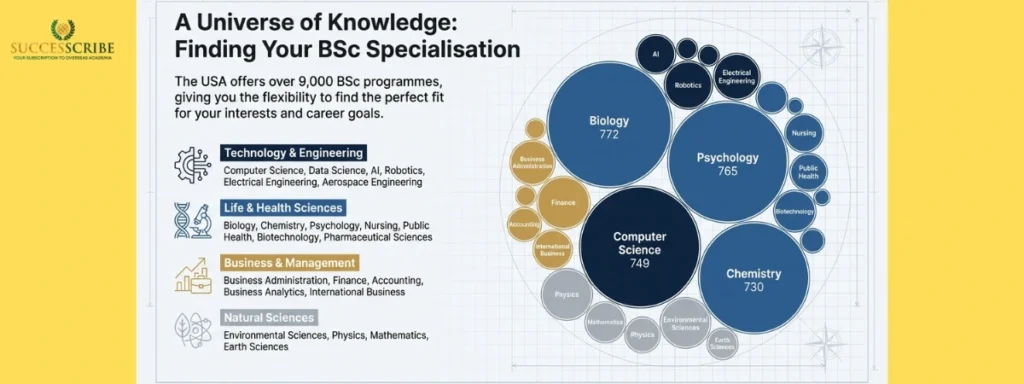
The United States offers one of the widest and most flexible ranges of Bachelor of Science (BSc/BS) degrees in the world. Unlike many countries where science degrees are limited to traditional subjects, US universities design BSc programs to align closely with industry needs, technological advancements, and research innovation. As of 2026, students can choose from hundreds of specialized and interdisciplinary science majors.
Broadly, Bachelor of Science in USA can be classified into the following major categories:
1. Natural & Physical Sciences
These programs focus on understanding the fundamental laws of nature and scientific principles through theory, experimentation, and laboratory work. They are ideal for students interested in research, academia, healthcare, or further studies such as MS, PhD, or medical programs.
Popular majors include:
- Biology
- Chemistry
- Physics
- Earth Science & Geology
- Environmental Science
- Atmospheric & Climate Science
Career pathways include research scientist, lab analyst, environmental consultant, healthcare researcher, and academic roles.
2. Technology & Computing Sciences
Technology-focused BSc degrees are among the most in-demand programs in the USA, driven by the country’s strong tech ecosystem and innovation economy. These programs emphasize coding, data analysis, system design, and emerging technologies.
Popular majors include:
- Computer Science
- Data Science
- Information Technology
- Artificial Intelligence & Machine Learning
- Cybersecurity
- Software Engineering
Graduates often pursue careers as software developers, data analysts, AI engineers, cybersecurity specialists, and IT consultants, with some of the highest starting salaries among BSc graduates.
3. Engineering & Applied Sciences
Engineering and applied science BSc degrees combine scientific theory with practical problem-solving and real-world applications. US universities are globally recognized for their strong engineering infrastructure, laboratories, and industry collaborations. Students pursuing a Bachelor of Science in USA in engineering benefit from world-class laboratories, hands-on design projects, and close collaboration with industry leaders.
Popular majors include:
- Mechanical Engineering
- Electrical & Electronics Engineering
- Civil Engineering
- Chemical Engineering
- Biomedical Engineering
- Industrial Engineering
These programs are particularly suitable for students aiming for STEM careers, professional licensure, or advanced technical roles in industries such as manufacturing, construction, healthcare, and technology.
4. Health & Life Sciences
Health and life science BSc degrees focus on human health, biological systems, and medical research. These programs are ideal for students planning careers in healthcare, pharmaceuticals, biotechnology, or public health, or those preparing for professional degrees such as medicine or dentistry.
Popular majors include:
- Biotechnology
- Microbiology
- Biomedical Sciences
- Neuroscience
- Public Health
- Genetics
Graduates can work in research labs, hospitals, pharmaceutical companies, and healthcare organizations, or continue with higher education.
5. Mathematical & Analytical Sciences
These programs emphasize logical reasoning, quantitative analysis, and statistical modeling, forming the backbone of many modern industries such as finance, data science, economics, and technology.
Popular majors include:
- Mathematics
- Applied Mathematics
- Statistics
- Actuarial Science
- Computational Mathematics
Students graduating from these programs are highly valued for roles requiring analytical thinking, problem-solving, and data-driven decision-making.
6. Business and Economics
Business-related Bachelor of Science in USA degrees prepare students for management, finance, marketing, and entrepreneurship roles.
Popular Concentrations:
- Finance
- Accounting
- Marketing
- Business Analytics
- Supply Chain Management
7. Interdisciplinary & Emerging Science Programs
One of the biggest strengths of the US education system is its focus on interdisciplinary learning. Many universities now offer innovative BSc programs that combine multiple scientific disciplines to meet evolving global challenges.
Popular interdisciplinary majors include:
- Environmental Engineering & Sustainability
- Bioinformatics
- Data Analytics
- Cognitive Science
- Materials Science
- Renewable Energy Systems
These degrees prepare students for future-focused careers and research areas that do not fit into a single traditional discipline.
The STEM Advantage: International students must prioritize “STEM-designated” majors. These programs are favored by US regulators, providing a crucial 36-month window of work authorization, which serves as the ultimate catalyst for international career ROI.
Top BS Majors in the USA and Job Market Outlook
The U.S. Bureau of Labor Statistics (BLS) projects that STEM occupations will grow by 8.1% through 2034, compared to just 2.7% for non-STEM roles.
| Major | Growth Rate | Avg. Starting Salary |
| Computer Science (AI Focus) | 26% | $95,000 – $125,000 |
| Nursing (B.S.N.) | 15% | $82,000 |
| Data Science / Business Analytics | 35% | $88,000 |
| Biomedical Engineering | 10% | $79,000 |
| Sustainability / Green Energy | 18% | $72,000 |
High-Value Disciplines: Market Dynamics and 2026 Reality
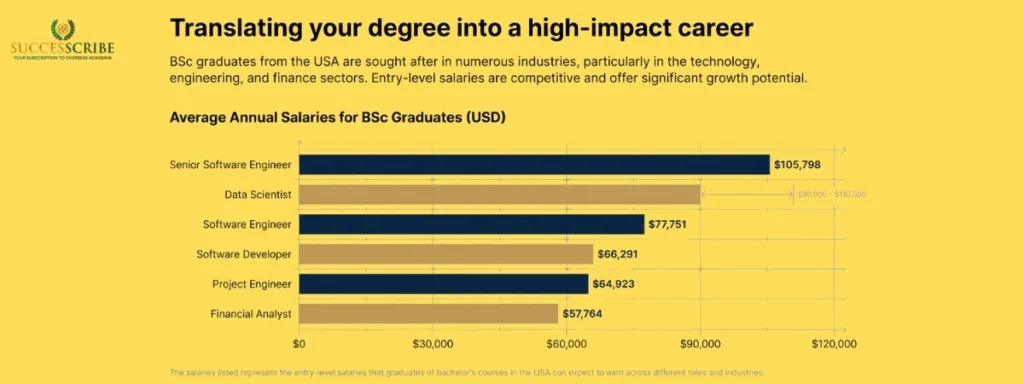
The economic landscape of 2025 – 2026 dictates a “Skills-First” hiring paradigm. Siloed knowledge is being replaced by integrated disciplines. Employers no longer value a biologist who cannot handle big data, or a computer scientist who cannot interpret business analytics. A BS degree is the non-negotiable entry-level requirement for this innovation economy.
Strategic Major Evaluation
| Major | Core Skills Gained | Primary Industry Demand | Starting Salary Range (USD) | Growth Trajectory (2026 – 2030) |
| Data Science | Big Data, Predictive Modeling, AI | Business Intelligence, FinTech | $90,000 – $110,000 | Exponential: Foundational to all industry automation. |
| Software Engineer | System Design, AI Integration | Big Tech, Defense, Logistics | $77,751 | High: Shift toward “AI-Orchestration” roles. |
| Software Developer | System Design, AI Integration | Big Tech, Defense, Logistics | $77,751 | High: Shift toward “AI-Orchestration” roles. |
| Software Developer | Programming, App Architecture | Tech Startups, E-commerce | $66,291 | Stable: Transitioning toward low-code supervision. |
| Senior Software Eng. | Strategic Architecture, Lead Dev | FAANG, Global FinTech | $105,798 | Very High: Critical shortage of high-level architects. |
| Project Engineer | System Integration, Management | Manufacturing, Construction | $64,923 | High: Essential for large-scale infrastructure projects. |
| Biomedical Eng. | Informatics, Imaging, Biomechanics | Pharma, MedTech | $65,000 – $85,000 | Rapid: Driven by the aging population and biotech. |
| Nursing (BSN) | Clinical Research, Patient Care | Healthcare Systems, Biotech | $60,000 – $75,000 | Critical: Structural shortage ensuring long-term demand. |
| Financial Analyst | Quantitative Risk, Forecasting | Wall Street, Corporate Finance | $57,764 | Stable: Increasingly automated; shifting toward strategy. |
Internships, Research & Why the US Has an Edge
US universities invest billions annually in undergraduate research.
- NSF-funded projects
- Paid internships from Year 2
- Co-op programs integrated into degrees
This early exposure explains why US BSc graduates are job-ready, not just degree-holders.
Best Universities in the USA for Bachelors of Science
Strategic selection mandates a rigorous calibration of institutional research output against capital expenditure. While rankings offer a baseline, the “best fit” involves assessing the infrastructure of private Ivies versus the scale of public Research I universities.
| University Name | Specialization Strength | Global Rank (QS) | Annual Tuition (USD) | Location |
| MIT | Engineering & Physics | 1 | $64,300 | Cambridge, MA |
| Stanford University | Computer Science & AI | 6 | $54,315 | Stanford, CA |
| Harvard University | Life Sciences & Psychology | 4 | $50,080 | Cambridge, MA |
| Caltech | Data Science & Physics | 10 | $64,100 | Pasadena, CA |
| Univ. of Pennsylvania | Economics & Finance | 11 | $57,400 | Philadelphia, PA |
| UC Berkeley | Environmental Sciences | 12 | $40,336 | Berkeley, CA |
| Johns Hopkins University | Biomedical Engineering | 10 (THE) | $64,700 | Baltimore, MD |
| Columbia University | Applied Physics/Math | 22 | $59,244 | New York, NY |
| Cornell University | Agriculture & Life Sciences | 16 | $71,300 | Ithaca, NY |
| Yale University | Computer Science | 23 | $67,600 | New Haven, CT |
Private Ivy League institutions offer elite networking and small-group mentorship. Conversely, public institutions like UC Berkeley offer massive research infrastructure and a hyper-competitive environment that mirrors the intensity of the Silicon Valley workforce.
Top-ranked institutions offering a Bachelor of Science in USA are known for their research intensity, global reputation, and strong graduate employability outcomes.
Apply to Top European Universities
Make your application simple and stress-free with Successcribe
Get Expert Help NowAdmission Requirements for BS Programs in USA
The admission process for a Bachelor of Science in USA at top schools is highly competitive, requiring stellar academics and a compelling holistic profile. Admission cycle marks a significant shift as several top-tier institutions have ended their “test-optional” era.
Academic Prerequisites
- GPA: For top-50 universities, a minimum 3.7/4.0 is usually required. For B.S. programs, high grades in Calculus, Physics, and Chemistry are prioritized.
- SAT/ACT: MIT, Harvard, Caltech, and Yale now require standardized test scores again. Target scores for B.S. applicants often fall in the 1510–1580 (SAT) or 34–36 (ACT) range.
- English Proficiency:
- IELTS: 7.0 – 7.5
- TOEFL iBT: 100+ (with sub-scores of 25+)
- Duolingo (DET): 130+
Holistic Review Components
U.S. admissions use a “Holistic Review” process. This means your “Stats” (GPA/Tests) only account for about 50% of the decision. The rest comes from:
- Statement of Purpose (SOP): Narrating your passion for your chosen B.S. field.
- Letters of Recommendation (LORs): Usually two from science/math teachers and one from a counselor.
- Extracurriculars: Research projects, coding bootcamps, or science Olympiads
Application Materials
- Online Application: Common Application, Coalition Application, or university-specific portal
- Application Fee: $50-$150 per university
- Academic Transcripts: Official high school records
- Letters of Recommendation: 2-3 from teachers or counselors
- Personal Statement/Essays: 500-650 words demonstrating motivation and fit
- Resume/CV: Listing extracurricular activities, leadership, volunteer work
- Financial Documentation: Bank statements showing ability to fund education
Student Visa Requirements (F-1 Visa)
Eligibility Criteria:
- Acceptance at SEVP-certified institution
- Full-time student status (minimum 12 credit hours per semester)
- Sufficient financial resources
- Intent to return to home country after studies
- English language proficiency
Required Documents:
- Form I-20: Certificate of Eligibility issued by university
- Valid Passport: Valid for at least 6 months beyond program completion
- DS-160 Form: Online nonimmigrant visa application
- SEVIS Fee Receipt: $350 fee payment (2025-26)
- Visa Application Fee: $160
- Financial Documents: Bank statements, scholarship letters, sponsor affidavits
- Academic Documents: Transcripts, diplomas, test scores
- Passport Photos: Recent photographs meeting specifications
Cost of Studying Bachelors of Science in USA
The cost of a B.S. degree varies significantly between public state universities and private elite institutions.
Average Annual Cost of Attendance
| Type of Institution | Average Tuition | Total Budget (Incl. Living) |
| Public (In-State) | $11,950 | $27,500 |
| Public (Out-of-State) | $31,880 | $52,000 |
| Private Nonprofit | $45,000 – $67,000 | $78,000 – $95,000 |
Cost of Living by Region
Living costs vary based on the “tier” of the city.
- Tier 1 (NYC, SF, Boston): $2,500 – $3,500/month.
- Tier 2 (Austin, Atlanta, Chicago): $1,800 – $2,400/month.
- Tier 3 (Oklahoma City, Indianapolis): $1,200 – $1,700/month.
STEM OPT Extension: The 3-Year Work Advantage
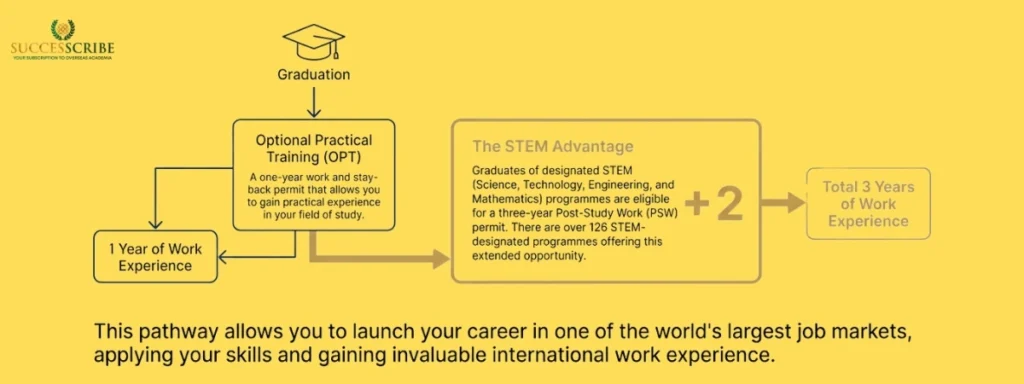
One of the primary reasons international students choose a Bachelor of Science in USA is the Optional Practical Training (OPT).
| Feature | Standard OPT (Non-STEM) | STEM OPT Extension |
| Initial Duration | 12 Months | 12 Months |
| Extension | N/A | + 24 months |
| Total Duration | 12 Months | 36 Months |
| Employer Rule | Any related field | Must be E-Verify Registered |
| Unemployment Limit | 90 Days | 150 Days (Total) |
For 2026, the Department of Homeland Security (DHS) has expanded the “STEM Designated Degree Program List” to include more interdisciplinary fields like Environmental Economics and Data Visualization.
Conclusion
A Bachelor of Science in USA is the premier pathway for global scientific leadership. It provides more than just a credential; it is a point of entry into the world’s most robust innovation ecosystem. For the high-achieving student, this degree transcends academic boundaries, offering a transformative journey from student to global innovator. Strategic navigation, beginning with an early Fall intake focus and a resilience-based fit assessment, is the key to unlocking this unrivaled career advantage.
FAQs
Is a Bachelor of Science in the USA worth the cost?
Yes – if chosen strategically and aligned with career goals.
Can I change my major in the USA?
Yes. Nearly 30–35% students change majors at least once.
Is US BSc better than UK BSc?
Depends on learning style. US offers more flexibility and exposure.
Is a 3-year degree from my home country enough to enter a US BS mid-way?
The “16-year rule” is the standard. Most US universities require 12 years of high school plus 4 years of undergraduate study. To transfer mid-way, you must undergo a WES (World Education Services) or EP (Educational Perspectives) evaluation. These services perform a credit-by-credit analysis to determine if your 3-year degree is functionally equivalent to the US credit system. Typically, a 3-year degree is evaluated as 90 credits, meaning you would need to complete at least one more year (30 credits) in the USA to earn your BS
Does the prestige of my specific major matter more than the university ranking?
In the STEM world, yes. A BS in Computer Science from San Jose State University (ranked lower globally) often has a higher ROI than a general degree from a top-20 Ivy because of its location in the heart of Silicon Valley and its deep industry partnerships with Cisco, Google, and Apple.
Related Post
Profile building bachelors in USA
Data science courses and in USA
Cyber security courses in USA
Dental hygienist course in USA