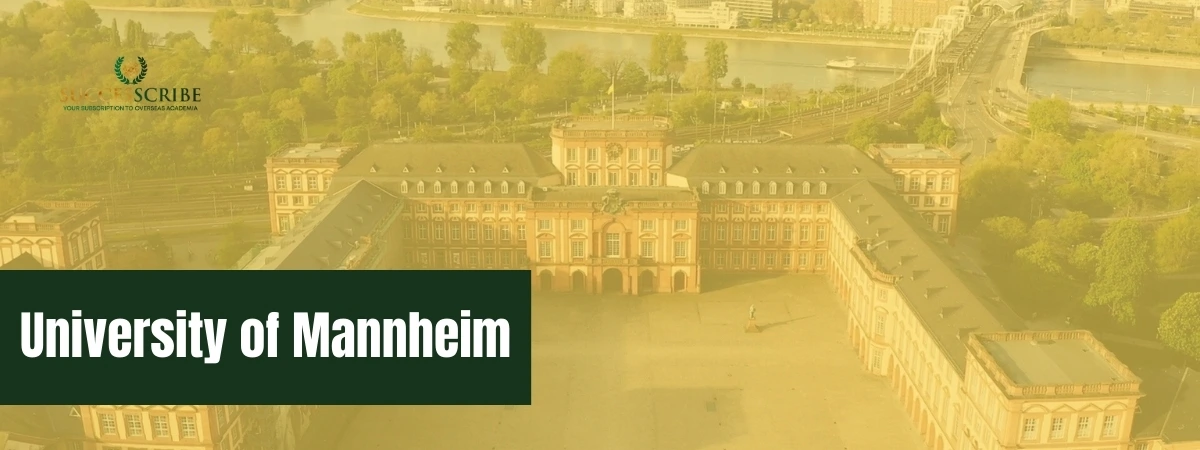
The University of Mannheim (UMA) stands as one of Germany’s most prestigious public research institutions. Often referred to as the “Harvard of Germany” due to its world-class Business and Economics programs, the university is uniquely housed within the Mannheim Palace, the largest Baroque palace in Germany. As of 2026, the university continues to bridge the gap between historical heritage and cutting-edge digital innovation.
Key Highlights: University of Mannheim
- Historical Evolution: From Palatine Academy to Research Powerhouse
- Campus and Infrastructure: Living in the Mannheim Baroque Palace
- Ranking and Reputation: University of Mannheim
- Acceptance Rate: University of Mannheim
- Faculty, Schools, and Departments: University of Mannheim
- Top Programs (Bachelor’s and Master’s)
- Tuition Fees, Cost of Living, and Scholarships: University of Mannheim
- Admission Requirements – University of Mannheim
- Student Life and the International Community
- Career Prospects and Industry Connections
- Notable Alumni
- Conclusion
- FAQs
Want to Study in Germany?
Start your journey with Successcribe’s free expert guidance
Book a Free Session NowHistorical Evolution: From Palatine Academy to Research Powerhouse
The University of Mannheim’s academic identity is deeply rooted in the Palatine heritage of commerce and Enlightenment-era intellectual rigor. The university’s motto, In Omnibus Veritas Suprema Lex Esto (“Truth in everything should be the supreme law”), reflects its commitment to empirical evidence and practical application.
- 1763: Elector Carl Theodor founds the Palatine Academy of Sciences, establishing the intellectual foundations within the Mannheim Baroque Palace.
- 1907: Establishment of the Municipal Commercial College (Handelshochschule) to support Mannheim’s rise as a merchant hub.
- 1933 – 1945: The institution is purged of Jewish faculty, including Rector Otto Selz; the Palace is almost entirely destroyed by 150 air raids during WWII.
- 1967: The institution is officially designated as the University of Mannheim, expanding its mandate to include Law and Humanities.
- 2026: Modern status as a global leader in management analytics and sustainability, integrated into the European “ENGAGE.EU” network.
This legacy of resilience has forged the “Mannheim Spirit” – a culture of persistence and excellence that transforms students into highly adaptable global leaders.
Campus and Infrastructure: Living in the Mannheim Baroque Palace
Studying at Mannheim offers the rare privilege of attending lectures within one of Europe’s largest Baroque palaces. This 18th-century architectural masterpiece serves as the heart of a 74-acre urban campus where historical grandeur meets 2026 state-of-the-art research infrastructure.
Key Infrastructure Points:
- The Mannheim Palace: The central hub housing the Business School, the Law School, and the University Library (A3), which hosts over one million volumes.
- Campus East vs. Campus West: Academic life extends from the Palace (East) to the modern research squares of A5 and B6 (West), facilitating a seamless integration into the city.
- Technologies d’avenir (2026): A forward-looking mobility initiative offering stipends of €1,200 to €2,100 per month for Master’s and PhD students conducting research stays in France, focused on AI and environmental energy.
- Modern Research Centers: Includes the Mannheim Centre for European Social Research (MZES) and the ZEW – Leibniz Centre for European Economic Research.
The city of Mannheim’s unique “Quadrats” (grid layout) ensures exceptional mobility. Students can navigate the entire academic core on foot or via the “Nextbike” system, which offers the first 30 minutes of travel for free.
Ranking and Reputation: University of Mannheim

Mannheim is consistently the top-ranked university in Germany for Business Administration and Economics. In 2026, its reputation among global employers reached a new peak.
| Ranking Body | Global Rank (2026) | National Rank (Germany) | Top – Ranked Subject |
| QS World University Rankings | #416 | #22 | Accounting & Finance (#1 in Germany) |
| Times Higher Education (THE) | #201–250 | #18 | Business & Economics (#33 globally) |
| Shanghai Ranking | #35 (Subj.) | #2 | Political Science & Finance |
| Wirtschaftswoche | N/A | #1 | Business Administration (Recruiter Choice) |
These rankings confirm that a Mannheim degree is a high-value asset, commanding immediate respect from “DAX” companies and global “Big Three” consultancies.
Acceptance Rate: University of Mannheim
University of Mannheim is known for its rigorous academic standards and selective admissions – particularly in sought-after programs such as business, economics, and quantitative social sciences.
General Acceptance Rate
While public German institutions typically do not publish official acceptance statistics, reliable estimates place the university’s overall acceptance rate at approximately 30 – 36%, indicating competitive selection processes for admission.
Program-Specific Notes
Certain programs are more selective than others:
- Mannheim Business School (MBA): Around 17–20% acceptance rate for full-time MBA programs, reflecting high selectivity in global business education.
- Master’s in Economics/Data Science and top social science programs also draw large application volumes with competitive entry standards.
Faculty, Schools, and Departments: University of Mannheim

The University of Mannheim’s academic architecture is designed for precision. Unlike many traditional German universities, it operates through five highly specialized Schools and two flagship Departments that act with the independence of mini-faculties.
| Unit | Key Departments / Programs | Unique Feature |
| Dept. of Law | Business Law, LL.B. / State Exam | Focus on Legal Tech & Digitalization |
| Dept. of Economics | Econometrics, Public Policy | Leader in Climate Economics Research |
| Business School | MMM, Finance, Operations | Two NEW M.Sc. programs launched |
| Social Sciences | Political Science, Psychology | MZES Social Data Science Hub |
| Informatics & Math | Business Informatics, Data Science | Expansion of AI & ML modules |
| Humanities | Media & Comm, Culture & Economy | Integration of Business-Humanities tracks |
1. Department of Law (Abteilung Rechtswissenschaft)
The Department of Law is renowned for its focus on Business Law and its innovative approach to the traditional German legal state examination.
- The Mannheim Integrated Model: It is one of the few places in Germany where law students can earn a Bachelor of Laws (LL.B.) after three years and then seamlessly proceed to the State Examination (Staatsexamen).
- International Focus: 2026 marks an expansion in the Master of Comparative Business Law (M.C.B.L.), a program delivered in English that attracts legal professionals from across the globe to study the intersection of European and International corporate law.
- Core Research: Focuses on digitalization in law, European competition law, and tax law.
2. The Department of Economics (Abteilung Volkswirtschaftslehre)
The Department of Economics is consistently ranked #1 in Germany and is a leader in Europe for empirical economic research.
- Quantitative Excellence: The department is heavily focused on Econometrics and Microeconomics. It houses the Collaborative Research Center (CRC TR 224), which received renewed funding in 2026 for its work on “Economic Perspectives on Societal Challenges.”
- Global Networking: It maintains close ties with the ZEW (Leibniz Centre for European Economic Research), providing students with direct access to top-tier economic policy consulting and data.
- 2026 Focus: Increased emphasis on Climate Economics and Social Inequality within the Master’s curriculum.
3. The Business School (Mannheim Business School)
The Business School remains the most internationally recognized unit of the university, holding the “Triple Crown” of world accreditations.
- Specialized Areas: Accounting & Taxation, Banking & Finance, Marketing, and Strategic Management.
- 2026 New Launches: M.Sc. Finance, Accounting & Taxation (MMFACT) – A data-driven approach to global finance. M.Sc. Operations & Supply Chain Management (MMOSCM) – Focused on AI-integrated logistics and sustainability.
- The MBA Hub: Through the Mannheim Business School gGmbH, it offers the Full-Time MBA and Executive MBA, often ranked top in Germany by the Financial Times.
4. School of Social Sciences
A world leader in political and behavioral research, this school is the heart of empirical analysis in Germany.
- Departments: Political Science, Sociology, and Psychology.
- Research Strength: Home to the MZES (Mannheim Centre for European Social Research). In 2026, the school is at the forefront of Social Data Science, utilizing big data to track democratic trends and public interest.
- Reputation: Ranked #59 globally in the 2026 THE Subject Rankings.
5. School of Business Informatics and Mathematics
This school provides the “technical engine” for the university, ensuring every Mannheim graduate is digitally literate.
- Departments: Mathematics and Computer Science (Informatics).
- Key Initiatives: The Mannheim Center for Data Science (MCDS) operates here, bridging the gap between mathematical theory and business application.
- Programs: Offers the highly popular M.Sc. Data Science, which is now integrated with AI-ethics modules as of the 2026 curriculum.
6. School of Humanities
The School of Humanities focuses on the “Mannheim Model,” which blends classical liberal arts with economic utility.
- Specializations: History, Philosophy, Media and Communication, and Linguistics.
- Hybrid Innovation: The B.A. Culture and Economy remains a standout program, allowing students to major in a language or history while taking a “minor” in Business Administration or Economics – making them highly employable in the global creative and corporate sectors.
Top Programs (Bachelor’s and Master’s)
Mannheim is known for its interdisciplinary approach. In Fall 2026, two new high-demand programs were launched to address the evolving financial landscape.
Bachelor’s Programs
The University of Mannheim offers a wide range of undergraduate programs. Some of the most sought-after include:
| Program Name | Duration | Language | Notes |
| BSc Business Administration | 3 Years | English/German | Highly competitive, strong placement outcomes |
| BSc Economics | 3 Years | English/German | Excellent quantitative foundation |
| BA Social Science | 3 Years | German | Analytical and empirical focus |
| B.A. in Law | 3 years | German | Pathway to legal practice |
| BSc Business Informatics | 3 Years | German | Tech-Management Integration |
Master’s Program
Mannheim’s graduate programs attract students globally due to their academic rigor and strong career pathways:
| Program | School | Duration | Language | Notable Information |
| M.Sc. in Management | Mannheim Business School | 2 years | English | Highly ranked globally |
| MBA (Full-Time) | Mannheim Business School | 1–2 years | English | Selective, high ROI |
| M.Sc. in Economics | School of Economics | 2 years | English | Strong quantitative content |
| M.A. in History | Humanities | 2 years | German | Research-oriented degree |
| M.Sc. Finance, Accounting & Taxation | Mannheim Business School | 2 years | English/German | Designed for the digital tax and fintech era |
| M.Sc. in Data Science | Math & Computer Science | 2 years | English/German | Increase job demand |
| M.Sc. Operations & Supply Chain Management | Mannheim Business School | 2 years | English/German | Focuses on AI-driven logistics and sustainability. |
Tuition Fees, Cost of Living, and Scholarships: University of Mannheim
The University of Mannheim presents a unique dual-pricing model. While standard degrees are heavily subsidized by the German state, the Mannheim Business School (MBS) operates on a self-funded basis, offering world-class infrastructure and networking that rivals top American Ivy League institutions.
Academic Tuition Fees
Fees are categorized based on residency and the specific nature of the degree.
| Program Type | EU/EEA Students | Non-EU Students | Note |
| Bachelor’s & Master’s | €0 | €1,500 / Semester | Standard public tuition |
| Full-Time MBA | €47,000 | €47,000 | Total program cost (12-15 months) |
| Executive MBA | €55,000 | €55,000 | Part-time for senior leaders |
| Second Degree | €650 / Semester | €1,500 / Semester | For those already holding a degree |
The Semester Contribution: In addition to tuition, all students (including Germans) pay a mandatory Semester Fee of €195. This covers administrative costs and gives you a heavily discounted “D-Ticket JugendBW” for unlimited trains and buses across Germany.
Monthly Cost of Living
Mannheim is often described as “mid-tier” in terms of cost – significantly more affordable than Munich or Stuttgart, but slightly more expensive than cities in Eastern Germany. For a comfortable student life, budget for €1,000 to €1,200 per month.
| Expense Category | Monthly Cost (Est.) | Savings Tip |
| Rent & Utilities | €450 – €650 | Apply for Studierendenwerk dorms 6 months early. |
| Health Insurance | €145 – €165 | Mandatory for students; price is fixed for those under 30. |
| Groceries & Food | €250 – €300 | Eat at the Mensa am Schloss (student canteen). |
| Leisure & Personal | €150 – €200 | Use your student ID for museum and cinema discounts. |
| Total Monthly | €1,100 | – |
Financial Requirements: The “Blocked Account”
For international students requiring a visa, the German government has updated the financial proof requirements for 2026. You must prove you have €11,904 available for your first year.
- Monthly Allowance: The bank will release €992 per month to your current account.
- Working While Studying: International students can work 140 full days per year. In Mannheim’s thriving economy, many students find “Working Student” (Werkstudent) positions at companies like SAP or BASF, earning between €15 and €20 per hour.
ROI (Return on Investment)
While a €47,000 MBA or a €3,000/year Master’s might seem like a major investment, the career outcomes in 2026 remain stellar:
- Average Starting Salary (MBA): €110,000+.
- Average Starting Salary (M.Sc. Management): €75,000+.
- Placement Rate: Over 90% of graduates secure a role within 3 months of graduation.
Scholarship Opportunities
- Deutschlandstipendium: EUR 300 per month for high-achieving students.
- DAAD Scholarships: Specifically for international graduates.
- Mannheim Scholarship: Targeted at talented students from diverse backgrounds.
- Opportunity Mannheim Scholarship: For students facing financial or social hardships.
Admission Requirements – University of Mannheim

The admission process is divided into two main streams: the Subsidized Bachelor/Master programs (managed by the University) and the Premium MBA programs (managed by Mannheim Business School).
1. Undergraduate Admissions (Bachelor’s)
Admission to Bachelor’s programs like Business Administration or Economics remains “numerus clausus” (NC), meaning it is highly competitive and based on a restricted number of seats.
- University Entrance Qualification: A German Abitur or an equivalent international secondary school certificate (e.g., IB, A-Levels).
- Language Proficiency:
| German | Most Bachelor’s programs require C1 Level (DSH-2 or TestDaF 4×4) |
| English | For the B.Sc. Business Administration, a B2/C1 level is required (IELTS 6.5+ or TOEFL 80+) |
- Selection Criteria: Mannheim uses a 100-point scale:
| GPA (Grade Average) | Up to 80 points. |
| Subject-Specific Tests | Up to 20 points (e.g., the SAT or the German TestAS can significantly boost your score). |
2. Graduate Admissions (Master’s – MMM & M.Sc.)
The Mannheim Master in Management (MMM) is famous for its strict entrance criteria. The university has fully transitioned to the GMAT Focus Edition.
| Requirement | Criteria |
| Academic Degree | Bachelor’s in Business/Economics (min. 180 ECTS). |
| Business Credits | At least 36 ECTS specifically in Business Administration. |
| GMAT Focus | Minimum 565 (Recommended: 615+ for competitive advantage). |
| GMAT (10th Ed.) | Minimum 600 (Only if taken before the test was retired). |
| English Skills | C1 Level (TOEFL iBT 100+ or IELTS 7.0+). |
| German Skills | Not required for the 100% English track. |
Pro Tip: Mannheim awards “Bonus Points” for relevant internships (at least 4 weeks) and semesters spent studying abroad during your Bachelor’s.
3. The Mannheim Full-Time MBA
The MBA requirements are professional rather than purely academic. This is a holistic review process.
- Work Experience: Minimum 3 years of post-graduate, full-time work experience.
- Leadership Potential: Proven track record of managing projects or teams.
- GMAT Focus Requirement: Minimum 565 is mandatory.
- The Interview Process: 1. Selection Interview: A 30-minute motivational deep-dive. 2. Case Study: Shortlisted candidates must present a business case solution to a faculty panel.
4. International Requirements (APS Certificate)
Students from India, China, and Vietnam must provide an APS Certificate (Akademische Prüfstelle) with their application. This is a mandatory verification of your academic documents and can take several months to process – start this at least 6 months before the July deadline.
- Certified Copies: Degree certificates and transcripts (translated to English or German).
- Test Results: GMAT Focus or GRE (sent directly via the testing agency).
- Language Proof: TOEFL/IELTS results (must be less than 2 years old).
- CV/Resume: A tabular CV highlighting professional and international experience.
- APS Certificate: (Only for applicants from India, China, or Vietnam).
Student Life and the International Community
The campus atmosphere is vibrant and multicultural, with 1,700 international students.
The Mannheim Experience
- Traditions: The Schlossfest (Palace Festival) brings 20,000 visitors to the campus, while the Schneckenhof parties in the palace quadrangle are legendary.
- Organizations: Over 50 initiatives, including Enactus and AIESEC, provide platforms for professional networking.
- Active Lifestyle: University Sports offers 82 disciplines, from rowing on the Neckar to E-Sports.
- Support: The “Buddy Program” offers dedicated integration support for Indian students, helping with everything from bureaucratic registration to local cultural immersion.
Career Prospects and Industry Connections
With a 95% placement rate, Mannheim graduates are among the most sought-after in Europe. The university’s proximity to “DAX” heavyweights ensures a direct talent pipeline.
Top Recruiters & Industry Partners
| Firm | Industry Sector |
| SAP / Amazon | Technology & E-commerce |
| McKinsey / BCG / Bain | Management Consulting |
| BASF / Porsche | Chemicals & Automotive |
| Deutsche Bank / Morgan Stanley | Banking & Finance |
Mannheim graduates command an average starting salary of €50,000–€60,000. International students benefit from the 120-day work permit rule, allowing them to gain professional experience while studying.
Notable Alumni: University of Mannheim
The University of Mannheim has produced an extraordinary roster of alumni who have risen to the highest levels of global business, economics, finance, and politics.
| Name | Sector | Notable Role / 2026 Status |
| Isabel Schnabel | Economics/Finance | Executive Board Member, European Central Bank (ECB). Influential voice in Eurozone monetary policy. |
| Hans-Peter Wild | Business | Owner & Chairman, Capri-Sun Group. Major philanthropist; funded the “Wild-Schlossfest” and university modernizations. |
| Malaika Mihambo | Sports/Society | Olympic Gold Medalist (Long Jump). Alumna of Social Sciences; 2026 advocate for youth sports and mental health. |
| Lea-Sophie Cramer | Entrepreneurship | Founder of Amorelie & Angel Investor. Leading figure in the German startup scene and 2026 board member for tech initiatives. |
| Stefan Lippe † | Business | Former CEO of Swiss Re. His legacy continues through university-endowed risk management research. |
| Philipp Hildebrand | Finance | Vice Chairman of BlackRock. Former President of the Swiss National Bank; global leader in sustainable investment. |
| Isabell Werth | Sports | World-Record Equestrian. The most successful Olympic equestrian in history; studied Business in Mannheim. |
| Claus Wellenreuther | Technology | Co-founder of SAP. Instrumental in establishing Mannheim as a hub for business informatics. |
| Christine Lambrecht | Politics | Former Federal Minister of Defence. Alumna of the Department of Law. |
| Clemens Fuest | Economics | President of the ifo Institute. One of Germany’s most cited economists and leading policy advisors in 2026. |
| Stephan Sturm | Healthcare/Biz | Former CEO of Fresenius. Leading manager in the healthcare and MedTech sectors. |
| Gitanas Nausėda | Politics | President of Lithuania. Graduate of the Department of Economics; strong advocate for EU-Baltic relations. |
Conclusion
The University of Mannheim offers an unmatched ROI: a world-class, Triple-Crown education for ~€3,000/year – roughly 10% of the cost of elite UK or US programs. In 2026, Mannheim’s strategic focus on AI, sustainability, and management analytics ensures its graduates are not just ready for the current market, but equipped to lead the next industrial revolution. For students seeking a “Debt-Free Global Career,” Mannheim is the definitive choice.
FAQs
Is the University of Mannheim a good university in Germany?
Yes. The University of Mannheim is considered one of Germany’s top public universities, especially for Business, Economics, Management, and Social Sciences. It consistently ranks among the top institutions nationally and is globally recognized in subject-specific rankings.
Does Mannheim offer help with the German language?
Yes, the university offers language cafés and courses at various levels to help international students reach the fluency needed for local employment.
What is the acceptance rate of the University of Mannheim?
The estimated overall acceptance rate is approximately 30–35%, although this varies by program. Competitive programs such as Business Administration, Economics, and the MBA are significantly more selective.
Can I transition from a Master’s into a PhD at the GESS?
Yes. Mannheim offers a “Fast Track” for high-performing Master’s students. If you maintain a GPA of 1.5 or better in your first year, you can apply for the Graduate School of Economic and Social Sciences (GESS) and begin your doctoral research while finishing your Master’s thesis.
What are the “Schneckenhof” parties everyone mentions?
The Schneckenhof is a courtyard within the palace and is the heart of Mannheim’s social life. Every Thursday during the lecture period, student committees organize legendary parties there. In 2026, these remain the primary way to integrate with German students if you are in an all-English Master’s track.
Related Post
Clausthal University of Technology
Leibniz University Hannover
Karlsruhe Institute of Technology
Humboldt University of Berlin