Entrepreneurship – the skill of creating, managing, and scaling a business venture – has become a core focus of higher education worldwide. In the United States, entrepreneurship education blends practical experience, theoretical grounding, mentorship, and access to startup ecosystems that rival anywhere in the world. Entrepreneurship Courses and Universities in USA offer students a powerful combination of academic excellence, real-world startup exposure, and access to the world’s most dynamic innovation ecosystems.
In 2026, entrepreneurship remains one of the fastest-growing academic fields in U.S. universities, with over 720 colleges and institutions offering dedicated programs across undergraduate, graduate, and certificate levels spanning business, engineering, sciences, and interdisciplinary tracks.
Key Highlights: Entrepreneurship Courses and Universities in USA
- Types of Entrepreneurship Programs in the USA
- The Top Entrepreneurship Universities in the USA
- Cost of Studying Entrepreneurship in the USA
- Core Curriculum Components: Entrepreneurship Programs in USA
- Admission Requirements and Eligibility Criteria for Entrepreneurship Courses
- Career Outcomes and Economic Impact After Graduate Entrepreneurship Programs
- The US Startup Ecosystem: University Incubators and Support
- Conclusion
- FAQs
Types of Entrepreneurship Programs in the USA
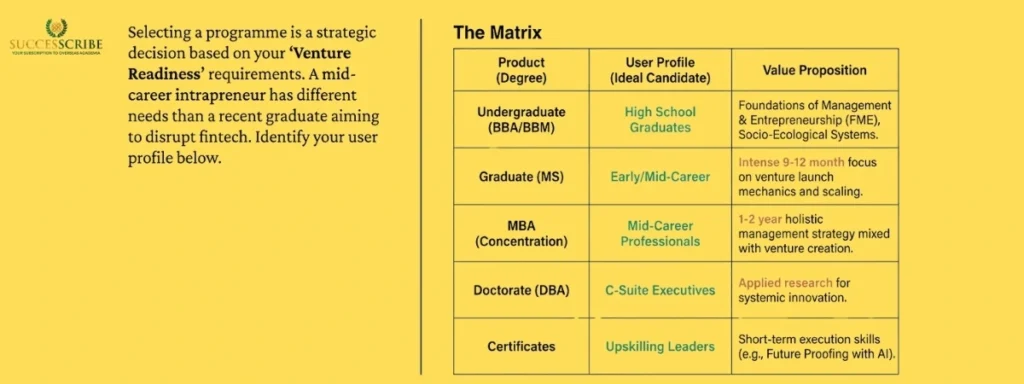
Selecting the appropriate academic pathway is a strategic decision that must align with an individual’s career stage, resource availability, and long-term objectives. In the 2026 landscape, the choice between a degree and a certificate is not merely about the credential, but about the depth of the “Venture Readiness” the student requires. A mid-career professional seeking to lead an internal innovation lab (intrapreneurship) has fundamentally different requirements than a recent graduate aiming to disrupt the fintech sector.
Tiers of Entrepreneurship Education
Entrepreneurship Courses and Universities in USA provide a wide range of academic pathways, including certificates, undergraduate degrees, master’s programs, MBAs, and executive education.
- Undergraduate (BBA/BBM): These programs focus on “Foundations of Management and Entrepreneurship” (FME), integrating liberal arts with business acumen. Students at this level are often introduced to “Socio-Ecological Systems,” learning to view business through the lens of global impact and sustainability.
- Graduate (MS, MBA): The Master of Science (MS) in Entrepreneurship is typically an intensive, 9-to-12-month program focused specifically on the mechanics of starting and scaling a business. The MBA offers entrepreneurship as a concentration, blending venture creation with broader leadership, finance, and organizational behavior skills.
- Doctor of Business Administration (DBA): A high-level professional offering that has gained significant traction by 2026. Designed for industry leaders, the DBA focuses on applying rigorous research to complex, real-world business challenges, enabling executives to drive systemic innovation.
- Professional Education & Certificates: These are targeted, short-term offerings for those seeking specific skills – such as “Future Proofing with AI” or “Opportunity Evaluation” – without the time commitment of a full degree.
Certificate vs. Degree Programs
| Program Type | Duration | Ideal Candidate | Core Focus | Credential Awarded | Typical Provider |
| Professional Certificate | 4–6 Weeks | Working Professionals | Specialized skills (e.g., AI in Business, Prototyping) | Digital Certificate | Harvard (HBS) Online |
| Executive Education | 1 Week – 1 Year | Senior Leaders | Strategic innovation and resilient leadership | Executive Certificate | Babson Academy / Harvard |
| Undergraduate Degree | 4 Years | High School Graduates | Business foundations + Entrepreneurial mindset | BBA or BBM | University of Houston / Babson |
| Master of Science (MS) | 9–12 Months | Early to Mid-Career | Venture launch, scaling, and entrepreneurial finance | MS in Entrepreneurship | University of Washington (Foster) |
| MBA (Concentration) | 1–2 Years | Mid-Career Professionals | Holistic management and venture strategy | MBA | Stanford GSB / UC Berkeley |
| Doctorate (DBA) | 3+ Years | C-Suite / Executives | Applied research and organizational change | DBA | Babson College |
The Top Entrepreneurship Universities in the USA
The 2026 rankings for entrepreneurship programs reflect an institutional commitment to experiential learning, faculty research, and, most importantly, career outcomes. Methodology for these rankings focuses on institutional survey data, including academic offerings, the density of the venture ecosystem, and the success rate of student-led startups.
Entrepreneurship Courses and Universities in USA are led by institutions that prioritize experiential learning, startup success, and strong alumni-driven ecosystems.
Top 25 Undergraduate Entrepreneurship Programs
| University Name | Location | Full-Time Enrollment |
| University of Houston | Houston, TX | 39,257 |
| University of Texas at Austin | Austin, TX | 43,165 |
| Babson College | Babson Park, MA | 2,793 |
| University of Michigan – Ann Arbor | Ann Arbor, MI | 34,454 |
| University of Washington | Seattle, WA | 40,754 |
| Washington University in St. Louis | St. Louis, MO | 8,220 |
| University of Maryland, College Park | College Park, MD | 31,133 |
| Michigan State University | East Lansing, MI | 41,234 |
| Iowa State University | Ames, IA | 25,628 |
| Tecnológico de Monterrey | Monterrey, MX | 61,486 |
| University of St. Thomas (MN) | Saint Paul, MN | 6,295 |
| Erasmus University Rotterdam | Rotterdam, NL | 23,000 |
| Syracuse University | Syracuse, NY | 15,957 |
| Northeastern University | Boston, MA | 22,695 |
| DePaul University | Chicago, IL | 14,188 |
| University of Miami | Coral Gables, FL | 13,250 |
| University of Iowa | Iowa City, IA | 22,738 |
| Florida State University | Tallahassee, FL | 32,711 |
| Florida Atlantic University | Boca Raton, FL | 25,209 |
| Drexel University | Philadelphia, PA | 13,169 |
| The University of Texas at Dallas | Richardson, TX | 21,858 |
| University of Utah | Salt Lake City, UT | 26,827 |
| Purdue University – West Lafayette | West Lafayette, IN | 39,170 |
| University of South Florida | Tampa, FL | 38,525 |
| University of Delaware | Newark, DE | 19,287 |
Apply to Top European Universities
Make your application simple and stress-free with Successcribe
Get Expert Help NowLeading Graduate and MBA Programs
Based on consistently strong performance in global entrepreneurship rankings, student outcomes, and ecosystem support, the following universities are widely regarded as leaders in entrepreneurship education at the graduate level.
| University | Location | Program Strengths |
| Rice University (Jones Graduate School of Business) | Houston, Texas | Venture creation focus, strong startup funding ecosystem, nationally known business plan competition |
| University of California, Los Angeles (UCLA – Anderson) | Los Angeles, California | Technology startups, media & entertainment entrepreneurship, venture capital access |
| University of Texas at Austin (McCombs School of Business) | Austin, Texas | Innovation management, tech entrepreneurship, strong Austin startup ecosystem |
| University of Michigan – Ross School of Business | Ann Arbor, Michigan | Action-based learning, corporate innovation, venture capital exposure |
| University of Washington (Foster School of Business) | Seattle, Washington | Technology and innovation entrepreneurship, strong links to global tech firms |
Elite MBA Programs with Strong Entrepreneurship Concentrations
In addition to dedicated entrepreneurship degrees, several top MBA programs in the USA offer highly respected entrepreneurship concentrations or tracks that allow students to specialize without limiting broader management exposure.
| MBA Program | Key Entrepreneurship Focus |
| Babson College – F.W. Olin Graduate School of Business | Globally recognized for entrepreneurship-first MBA curriculum |
| Stanford Graduate School of Business | High-growth startups, venture capital, Silicon Valley ecosystem |
| Harvard Business School | Case-based entrepreneurship learning, global venture exposure |
| University of California, Berkeley – Haas School of Business | Technology ventures, sustainability, innovation leadership |
| Cornell University – Johnson Graduate School of Management | Tech entrepreneurship, New York startup ecosystem, interdisciplinary innovation |
Program Duration & Structure
Graduate and MBA entrepreneurship programs in the USA typically follow these formats:
| Degree Type | Duration | Structure |
| Master’s in Entrepreneurship | 12–18 months | Focused venture creation, innovation strategy |
| MBA with Entrepreneurship Concentration | 18–24 months | Core MBA + entrepreneurship electives |
| Executive MBA (Entrepreneurship Focus) | 18–24 months (part-time) | Leadership, Scaling Business, Innovation |
Cost of Studying Entrepreneurship in the USA
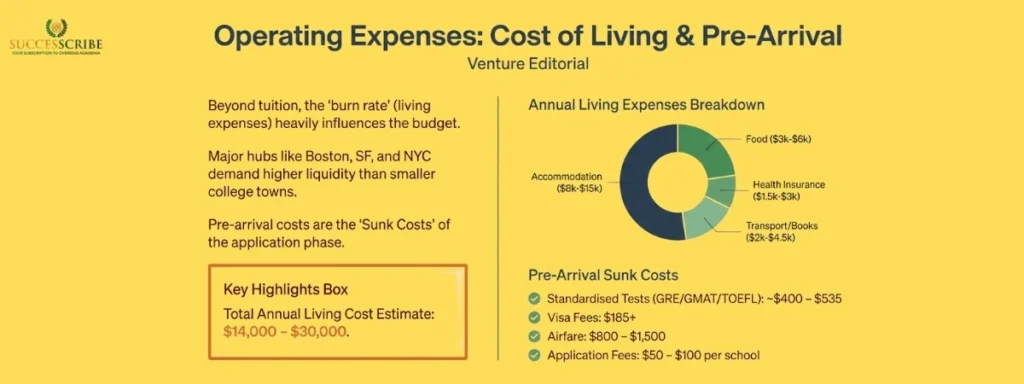
Understanding the complete cost of studying entrepreneurship in the United States is essential for students – especially international applicants – as it helps with budgeting, financial planning, and comparing programs. Entrepreneurship Courses and Universities in USA include multiple cost components such as tuition, living expenses, learning materials, and pre-arrival charges.
In 2026, the average cost of studying entrepreneurship programs in the USA varies significantly depending on the degree level (certificate, bachelor’s, master’s, MBA, online), type of institution (public or private), and location (major city vs smaller town).
Components of Total Study Cost
The total cost of studying in the USA typically consists of the following:
- Tuition & Fees
This is the primary expense and depends on the type of degree and school.
- Living Expenses
Includes accommodation, food, transportation, utilities, health insurance, and personal expenses.
- Study Materials
Books, software, laptops, and specialized equipment.
- Pre-Arrival/One-Time Costs
Application fees, visa costs, standardized tests (GRE/GMAT, TOEFL/IELTS), flight tickets, and initial setup costs.
Tuition Fee Estimates by Program Type
The tuition fees for entrepreneurship education in the USA vary widely based on degree level and institution:
1. Undergraduate (Bachelor’s) Programs
| Program Level | Typical Tuition (Per Year) | Notes |
| Public University (In-State) | $10,000 – $25,000 | Lower cost for residents |
| Public University (Out-of-State) | $25,000 – $40,000 | Standard for non-residents |
| Private University | $40,000 – $70,000+ | Higher but often strong entrepreneurship support |
The average undergraduate entrepreneurship tuition and fees for institutions offering these programs is roughly:
- In-State: $10,567
- Out-of-State: $30,449
2. Master’s Degree Programs in Entrepreneurship
| Program Type | Estimated Annual Tuition | Notes |
| Public University (In-State) | $15,000 – $30,000 | More affordable for residents |
| Public University (Out-of-State) | $25,000 – $40,000 | Standard for non-residents |
| Private University | $35,000 – $60,000+ | Premium resources and networks |
3. MBA Programs with Entrepreneurship Focus
MBA costs in the USA can vary significantly:
| School Category | Typical Annual Tuition | Example Range |
| Top Business Schools | $70,000 – $90,000+ | Prestigious MBA programs |
| Mid-Tier Business Schools | $40,000 – $70,000 | Excellent quality with lower fees |
| Public University MBA | $20,000 – $40,000 | More affordable for many students |
4. Online Programs
Online degrees are increasingly popular – especially for students balancing work or business ventures.
| Online Program Type | Typical Tuition Range |
| Online Master’s | $15,000 – $40,000 total |
| Online MBA | $20,000 – $45,000 total |
Living and Miscellaneous Costs
While tuition is the major part of the study cost, living expenses can add significantly to the total expenditure.
| Category | Estimated Annual Cost (USD) |
| Accommodation | $8,000 – $15,000 |
| Food | $3,000 – $6,000 |
| Transportation | $1,000 – $2,500 |
| Health Insurance | $1,500 – $3,000 |
| Books & Study Materials | $1,000 – $2,000 |
Total Living Cost: $14,000 – $30,000 per year (varies by city)
Note: Big cities like San Francisco, New York, and Boston tend to be more expensive (housing and food) compared with smaller towns or suburban campuses.
Pre Arrival Expenses
Before even arriving in the USA, students should plan for initial expenses, such as:
| Expense Type | Approximate Expense |
| Application Fees | $50 – $100 per application |
| GRE/GMAT | $230 – $275 |
| TOEFL/IELTS | $180 – $260 |
| Visa Fee | $185+ |
| Airfare from India | $800 – $1,500 (varies) |
These preliminary costs should be accounted for in your budget planning.
Core Curriculum Components: Entrepreneurship Programs in USA
While course content varies by institution, most strong entrepreneurship programs include:
- Business Planning & Strategy
- Market Research & Validation
- Financial Modeling & Funding
- Innovation & Design Thinking
- Startup Launch Labs
- Leadership & Team Dynamics
- Legal and Ethical Issues
- Digital Marketing & E-Commerce
- Pitch Competitions & Venture Funding
These courses typically blend classroom theory with real business projects, mentorship, and access to investor networks to prepare students for real-world entrepreneurship.
Admission Requirements and Eligibility Criteria for Entrepreneurship Courses
Admission to top-tier U.S. entrepreneurship programs in 2026 is highly competitive, necessitating a holistic application profile that demonstrates both academic excellence and entrepreneurial potential. Admissions committees look for “Entrepreneurial Leaders” – individuals who exhibit a blend of critical thinking, communication skills, and a proven track record of taking initiative. The application is viewed as a candidate’s first “pitch” to a group of stakeholders. Entrepreneurship Courses and Universities in USA maintain competitive admission standards that evaluate academic performance, leadership potential, and entrepreneurial vision.
Eligibility Criteria by Education Level
- Bachelors (Undergraduate)
- Certification: Completion of 12th-grade certification from a registered educational institution is the baseline.
- Academic Advantage: While not always mandatory, a background in business or commerce is viewed favorably by top-ranked programs like the University of Houston.
- Evaluation: Focus is placed on high school CGPA, extracurricular leadership, and the ability to articulate a vision for innovation in the application essay.
- Masters / MBA
- Academic Standing: A minimum CGPA of 2.5 out of 4.0 is generally required, though top-tier schools like Stanford or Wharton often look for a 3.5+ range.
- Prerequisites: A Bachelor’s degree (BBA preferred for some MS programs) is required.
- Standardized Testing: GMAT or GRE scores are central. Typical competitive ranges for 2026 include:
- ◦ GRE: 320 (with a minimum baseline of 290–300 for some MS programs).
- ◦ GMAT: 550 – 600 as a competitive baseline, though higher for elite MBA tracks.
- Professional Experience: While some MS programs accept fresh graduates, an MBA usually requires at least 2 years of substantive work experience.
- PhD / Doctorate
- Educational Prerequisite: A Master’s degree in entrepreneurship or a closely related management discipline.
- Research Focus: Candidates must demonstrate the ability to conduct high-level research. This often requires the vetting of previous research papers by the university’s academic committee.
- Standardized Testing: GRE scores (typically 300+) are standard.
The 7-Step Admission Process for International Students
- Eligibility Check: Research specific university and department requirements (GPA, standardized tests).
- Online Application: Complete the university’s application portal and pay the necessary fees.
- Document Submission: Upload official transcripts, SOPs, and LORs.
- Entrance Exams: Submit official TOEFL/IELTS and GRE/GMAT scores.
- Admissions Portal Monitoring: Regularly check for status updates and requests for interviews.
- Offer Response: If accepted, respond to the admission offer and pay the tuition deposit to confirm the seat.
- Visa Application: Upon receipt of the I-20 form, proceed with the F-1 Student Visa application.
Required Documentation and Proficiency Benchmarks
The documentation required serves as the evidentiary basis for a student’s potential:
- Statement of Purpose (SOP): A narrative detailing entrepreneurial aspirations and “bias for action.”
- Letters of Recommendation (LOR): Testimonials from academic or professional mentors regarding leadership and innovation capacity.
- Official Transcripts: Verified records of all previous academic coursework.
- Financial Support Proof: Evidence of the ability to fund the program and the cost of living (est. $18,000/year).
- English Proficiency:
- TOEFL: 90–100 (iBT) is the standard range.
- IELTS: 7.0 (with a minimum of 6.5 for specific tracks).
Career Outcomes and Economic Impact After Graduate Entrepreneurship Programs
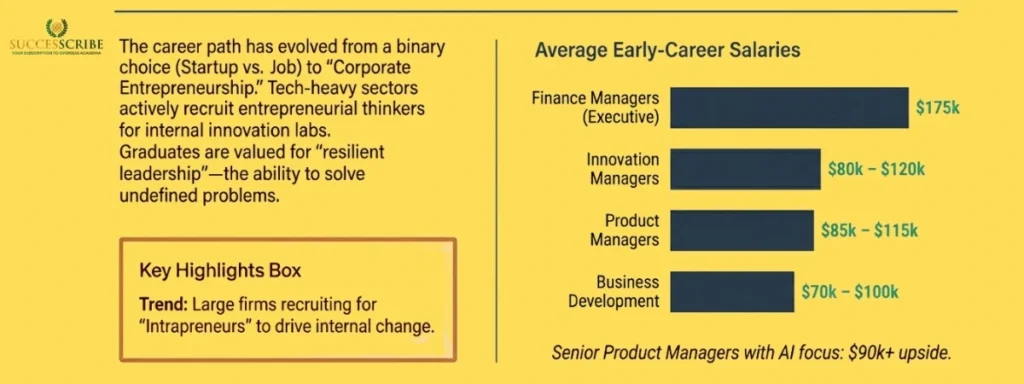
Entrepreneurship Courses and Universities in USA prepare graduates for diverse career paths, including startup founding, corporate innovation, and venture capital roles. Graduates of U.S. entrepreneurship programs pursue diverse and high-impact career paths, including:
- Startup Founder or Co-Founder
- Product Manager or Innovation Manager
- Venture Capital or Angel Investment Analyst
- Strategy Consultant or Business Development Manager
- Corporate Innovation Lead
While founder income varies widely depending on venture success, graduates entering professional roles typically see competitive salary growth, with strong long-term earning potential due to leadership and ownership opportunities.
According to employment trends data in entrepreneurship-related roles:
| Career Path | Average Early-Career Salary (USD) |
| Startup Founder (self-reported) | Depends on revenue growth |
| Product Manager | $85,000 – $115,000+ |
| Business Development | $70,000 – $100,000 |
| Innovation Manager | $80,000 – $120,000 |
The career trajectory for entrepreneurship graduates in 2026 has shifted from a binary choice (starting a company vs. getting a job) to a more integrated path known as “corporate entrepreneurship.” Large-scale firms in AI and tech-heavy sectors now actively recruit “entrepreneurial thinkers” to lead internal product development and innovation labs.
- Undergraduate Outcomes: The Babson Class of 2024 reported an average starting salary of $77,681. This reflects the high value employers place on the “problem-solving” and “resilient leadership” skills these graduates possess.
- Mid-Career and Executive Roles:
- Finance Manager: Average annual package of $175,000.
- Senior Product Manager: $90,000+ (with high upside in AI sectors).
- Executive MBA Outcomes: Average annual packages reaching $150,213.
- Economic Resilience: In 2026, an entrepreneurship degree is essentially a degree in “Adaptive Management.” Graduates are trained to pivot business models rapidly as technology evolves, making them some of the most recession-proof professionals in the global economy. Whether they are launching a tech venture or managing a department in a Fortune 500 company, their “bias for action” remains their most valuable asset.
The US Startup Ecosystem: University Incubators and Support
The success of U.S. entrepreneurship programs is largely due to their symbiotic relationship with the broader venture ecosystem, particularly in global hubs like Silicon Valley and the Boston-Cambridge corridor. Entrepreneurship Courses and Universities in USA benefit from close integration with startup incubators, accelerators, and investor networks. Universities act as catalysts, translating academic research into market-ready ventures.
Support Systems Beyond the Classroom
- Incubators & Accelerators: These provide more than just space. Babson’s Butler Launch Pad and the Stanford Venture Studio offer seed funding, mentorship, and administrative support. The “Fast Track Cohort” at Babson is a notable example of a dedicated support system for high-potential student ventures.
- Mentorship & Alumni Networks: Universities employ “Entrepreneurs in Residence” (EiR) – seasoned founders who provide one-on-one tactical guidance. LinkedIn has ranked Babson #1 for its Alumni Network, illustrating how these connections facilitate everything from hiring to Series B funding.
- Competitions: Events like the B.E.T.A. Challenge, Rocket Pitch, and the Wharton Startup Challenge allow students to pitch to real investors. These are not academic exercises; they often involve real equity interests and prize money designed to scale a venture immediately.
- Centers & Institutes: Organizations like the Blank Center for Entrepreneurship and the Center for Entrepreneurial Studies at Stanford serve as hubs for “Translational Research,” ensuring that breakthroughs in AI, biotech, and sustainability find their way into the commercial market.
Conclusion
A U.S. entrepreneurship education remains the global gold standard in 2026 because it does not just teach business – it cultivates a mindset. By blending the rigorous “Entrepreneurial Thought & Action” framework with the vast resources of the American venture ecosystem, these programs prepare students to lead in an era of unprecedented change. Entrepreneurship Courses and Universities in USA continue to set the global benchmark in 2026 by combining education, innovation, and real-world business impact.
FAQs
Why is the USA considered the best country to study entrepreneurship?
The USA offers one of the strongest startup ecosystems in the world, supported by leading universities, venture capital networks, accelerators, and innovation hubs such as Silicon Valley, New York, Boston, Austin, and Seattle. U.S. universities emphasize hands-on learning, funding access, and industry exposure, making them highly attractive for aspiring entrepreneurs.
What types of entrepreneurship courses are available in the USA?
Entrepreneurship courses in the USA are available at multiple levels, including:
1. Certificate and short-term programs
2. Associate degrees
3. Bachelor’s degrees in entrepreneurship
4. Master’s degrees in entrepreneurship
5. MBA programs with entrepreneurship specialization
6. Executive and online entrepreneurship programs
This flexibility allows students to choose programs based on their career stage and goals.
Which are the top universities for entrepreneurship in the USA?
Some of the most respected universities for entrepreneurship education in the USA include Babson College, Rice University, Stanford University, University of California – Berkeley, Harvard University, University of Texas at Austin, UCLA, and the University of Michigan. These institutions are known for strong startup ecosystems, experienced faculty, and successful alumni networks.
What is the duration of entrepreneurship programs in the USA?
The duration depends on the type of program:
Certificate programs: 6 weeks to 12 months
Bachelor’s degrees: 4 years
Master’s degrees: 12–24 months
MBA programs: 18–24 months
Executive programs: 12–24 months (part-time)
What career opportunities are available after completing entrepreneurship courses in the USA?
Graduates pursue careers such as:
1. Startup founder or co-founder
2. Product manager
3. Business development manager
4. Innovation consultant
5. Venture capital or startup analyst
6. Corporate entrepreneurship roles
Some graduates launch their own businesses, while others work in high-growth startups or established companies.
Related Post
Bachelor of science in USA
Profile building bachelors in USA
Dental hygienist course in USA
Engineering management courses in USA