
By the time you complete the first year of a Data Science PhD, the Large Language Model (LLM) you used to polish your application will likely be a legacy system. In the hyper-accelerated landscape of 2026, the primary dilemma for high-level practitioners isn’t whether the field is moving too fast for academia, but whether a Master’s degree still provides enough of a “moat” against the commodification of basic data skills. As a strategist, I view the five-year doctoral commitment not as a delay in career entry, but as a critical hedge – a path to becoming the architect of the tools that will define 2030, rather than a mere operator of today’s systems.
Key highlights: PhD in Data Science in USA
- Defining the 2026 Data Science Doctorate
- Why Pursue a PhD in Data Science in the USA?
- Duration of PhD in Data Science in USA
- Top Universities & Specializations
- Career Outcomes and 2026 Salary Benchmarks
- The 2026 Admission Roadmap: A Holistic Strategy
- Cost of PhD in Data Science in USA
- Technical Comparison: Data Science vs. Computer Science vs. AI
- Post-Doctoral Visa Pathways & The International Student Journey
- Advisor Selection Strategy: The Real Gatekeeper
- Internships During PhD: Industry Research Reality
- The Reality Check – Challenges and Considerations
- Conclusion
- FAQs
Defining the 2026 Data Science Doctorate
A PhD in Data Science is a research-intensive degree relying on a fusion of advanced mathematics and high-performance computation to solve complex global challenges. By 2026, these programs have moved beyond optional ethics to mandatory accountability; for example, the University of Chicago now mandates DATA 35900 (Responsible Use of Data and Algorithms) as a core requirement for all doctoral candidates.
2026 Research Frontiers
Doctoral candidates in 2026 focus on four primary frontiers:
- Generative AI & Deepfakes: Investigating synthetic data generation, deep learning architectures, and the mathematical detection of synthetic misinformation.
- Edge Intelligence: Decoupling AI from the cloud by bringing machine learning capabilities directly to the hardware frontier.
- Responsible & Data-Centric AI: Developing legal and ethical frameworks for data use, automated data cleaning, and ensuring algorithmic fairness.
- Augmented Analytics: Enhancing the human-data interface to visualize and communicate complex insights to non-technical stakeholders.
Mastering these areas requires a long-term commitment that balances rigorous foundations with the endurance necessary for a 4–6 year research marathon.
Why Pursue a PhD in Data Science in the USA?
Here are the prominent Reasons why pursue PhD in Data Science in USA:
1. World-Leading Research Ecosystem
The USA hosts globally renowned research institutions such as MIT, Stanford, Harvard, UC Berkeley, Carnegie Mellon, and Princeton, many of which operate dedicated AI and data science research centers. These universities receive billions of dollars annually in federal research funding from organizations like:
- National Science Foundation (NSF)
- National Institutes of Health (NIH)
- Department of Defense (DoD)
- Department of Energy (DOE)
In 2024 alone, US federal research funding exceeded USD 190 billion, a significant portion of which supported AI, data analytics, and computational research.
2. Strong Industry – Academia Collaboration
PhD students in data science frequently collaborate with global technology leaders such as:
- Microsoft
- Meta
- Amazon
- NVIDIA
- IBM Research
These collaborations often result in joint publications, patents, and industry internships, which significantly enhance career prospects after graduation.
3. Fully Funded Doctoral Programs
Unlike many countries, a PhD in Data Science in the USA is usually fully funded, meaning students receive:
- Full tuition waiver
- Annual stipend (USD 25,000 – 40,000)
- Health insurance
- Research and conference funding
This makes the USA one of the most financially viable destinations for doctoral studies.
Suggested Post: Best place to study in USA
Duration of PhD in Data Science in USA
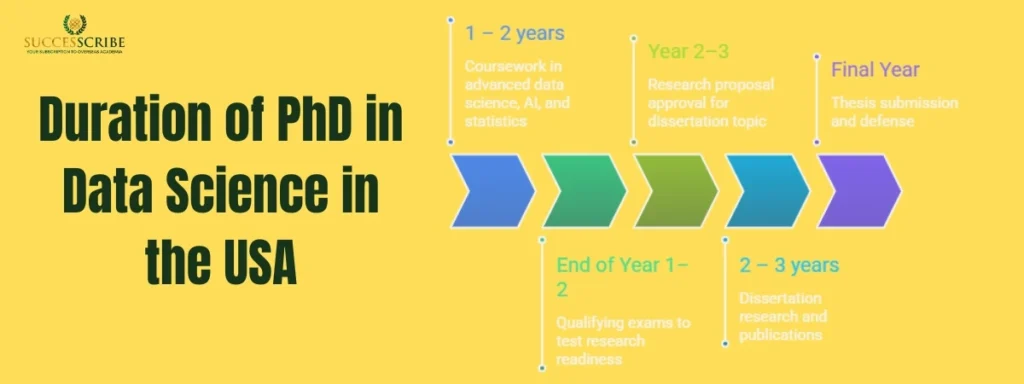
The average duration of a PhD in Data Science in the USA ranges from 4 to 6 years, depending on the university, research progress, and funding structure.
Typical PhD Timeline
| Phase | Duration | Description |
| Coursework | 1–2 years | Advanced subjects in data science, AI, statistics |
| Qualifying Exams | End of Year 1–2 | Tests research readiness |
| Research Proposal | Year 2–3 | Dissertation topic approval |
| Dissertation Research | 2–3 years | Original research & publications |
| Defense & Graduation | Final Year | Thesis submission and defense |
The PhD Journey: A Year-by-Year Breakdown
The road to “Doctor” is a marathon, not a sprint. In 2026, the timeline generally looks like this:
- Year 1: Foundations & Rotations. Heavy coursework. You may “rotate” through 2-3 different research labs to find the right advisor.
- Year 2: Qualification Exams. Often called “Comps.” This is a rigorous test of your breadth of knowledge. Once passed, you are a “PhD Candidate.”
- Year 3: Proposal & Deep Research. You define your original contribution to the field. You begin submitting papers to major conferences.
- Year 4: Specialized Research & Internships. Many students take a “Research Internship” at companies like OpenAI, Anthropic, or NVIDIA during the summer of Year 4.
- Year 5-6: Dissertation & Defense. Writing the book-length thesis and defending it before a committee of experts.
Top Universities & Specializations for Phd in Data Science in USA
The hierarchy of Data Science programs in 2026 reflects a blend of traditional Ivy League prestige and technical powerhouses. We are seeing a rise in “Data Science Institutes” within universities that operate independently of Computer Science departments.
| University | Core Specialization | Est. Duration | 2026 GRE Requirement | Funding Status |
| MIT (IDSS) | Social & Engineering Systems | 5-6 Years | Not Required | Fully Funded |
| Stanford University | Statistical Data Science | 5 Years | Optional | Fully Funded |
| Carnegie Mellon (MLD) | Machine Learning & Analytics | 5 Years | Required | Fully Funded |
| UC Berkeley | Computational Social Science | 5-6 Years | Not Required | Fully Funded |
| NYU (Center for DS) | Deep Learning & Healthcare | 5 Years | Optional | Fully Funded |
| University of Michigan | Data Mining & Bio-Statistics | 4-5 Years | Required | Fully Funded |
| Georgia Tech | High-Performance Computing | 5 Years | Required | Fully Funded |
| Harvard (IACS) | Applied Computation | 5 Years | Optional | Fully Funded |
| UW Seattle | E-Science & Data Management | 5 Years | Not Required | Fully Funded |
| UT Austin | Optimization & Algorithms | 5 Years | Required | Fully Funded |
Emerging Specializations for 2026
- Neuro-Symbolic AI: Combining deep learning with symbolic logic.
- Climate Informatics: Using massive planetary data sets to predict and mitigate climate events.
- Privacy-Preserving Analytics: Focusing on Differential Privacy and Federated Learning.
Career Outcomes and 2026 Salary Benchmarks
The ROI (Return on Investment) for a PhD in Data Science remains the highest in the academic world. In 2026, the industry demand for “Applied Scientists” and “Research Engineers” is at an all-time high.
| Role | Sector | Starting Salary (Base) | Total Compensation (Incl. Equity) |
| Research Scientist | Big Tech (FAANG+) | $190,000 | $310,000+ |
| Principal Data Scientist | FinTech/Hedge Funds | $210,000 | $400,000+ |
| Assistant Professor | R1 Research University | $125,000 | $150,000 (9-month) |
| AI Architect | Healthcare/Biotech | $175,000 | $240,000+ |
| Director of Data Science | Scale-up Startups | $220,000 | $350,000+ (Equity heavy) |
The 2026 Admission Roadmap: A Holistic Strategy
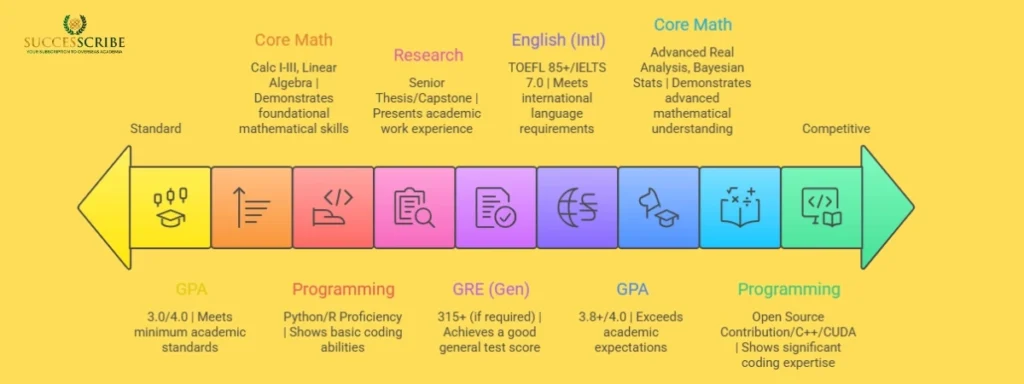
In 2026, the PhD admission process has shifted from a “numbers-only” game to a sophisticated “fit-assessment” model. While high test scores were once the primary gatekeepers, universities now use AI-assisted screening tools to evaluate the depth of your research contributions and your potential to thrive in a collaborative environment.
The Standard vs. Competitive Profile
To secure a spot in a fully funded program, you must understand the difference between meeting the “minimum” and being “competitive.”
| Feature | Standard Requirement | Competitive Profile (Top 20) |
| GPA | 3.0 / 4.0 | 3.8+ / 4.0 |
| Core Math | Calc I-III, Linear Algebra | Advanced Real Analysis, Bayesian Stats |
| Programming | Proficiency in Python/R | Contribution to Open Source / C++ / CUDA |
| Research | Senior Thesis or Capstone | 1-2 Peer-reviewed publications (NeurIPS, ICML) |
| GRE (Gen) | 315+ (if required) | 330+ (168+ Quantitative) |
| English (Intl) | TOEFL 85+ / IELTS 7.0 | TOEFL 100+ / IELTS 8.0 |
Technical Proficiency Requirements
| Subject Area | Required Competency |
| Multivariate Calculus | Proficiency in optimization and multidimensional analysis. |
| Linear Algebra | Mastery of Matrix Theory and vector spaces (Standard at NJIT/NYU). |
| Probability & Statistics | Deep understanding of statistical inference and distribution theory. |
| Data Structures | Efficiency in algorithm design and computational logic. |
| Programming | Advanced proficiency in Python, R, and/or SQL. |
SOP & Research Proposal: The Statement of Purpose must align personal research objectives with specific faculty interests to demonstrate high-level strategic fit.
Cost of PhD in Data Science in the USA
One of the most important and reassuring aspects of pursuing a PhD in Data Science in USA is that the majority of programs are fully funded. Unlike undergraduate or master’s degrees, doctoral programs in the United States are designed to support students financially so they can focus entirely on research and academic development.
However, understanding the actual cost structure – including tuition, living expenses, and what is covered by funding – is essential for making an informed decision.
1. Tuition Fees for PhD in Data Science in USA
In the USA, PhD tuition fees are typically waived for admitted students who receive funding (which includes most full-time PhD candidates).
Average Tuition Fees (Before Waiver)
| University Type | Annual Tuition (USD) |
| Public Universities (Out-of-State) | USD 25,000 – 45,000 |
| Private Universities | USD 45,000 – 65,000 |
Important Note:
Although these tuition amounts exist officially, funded PhD students do not pay these fees. The tuition is covered through:
- University fellowships
- Teaching Assistantships (TA)
- Research Assistantships (RA)
- Departmental or federal research grants
Net tuition cost for most PhD students: USD 0
2. Cost of Living by City Type
| City Category | Examples | Annual Living Cost (USD) |
| High-Cost Cities | New York, San Francisco, Boston | 28,000 – 35,000 |
| Medium-Cost Cities | Seattle, Chicago, Los Angeles | 22,000 – 28,000 |
| Low-Cost Cities | Texas, Midwest, Southern States | 18,000 – 22,000 |
3. Health Insurance Costs
Health insurance is mandatory for all international PhD students in the USA.
In most funded PhD programs Health insurance is fully covered or partially subsidized by the university.
Average Health Insurance Cost (If Not Fully Covered)
| Coverage Type | Annual Cost (USD) |
| University-Sponsored Plan | 1,500 – 3,000 |
| Student Contribution (after subsidy) | 0 – 800 |
4. Research, Conference & Academic Costs
PhD students in Data Science are expected to attend international conferences, workshops, and summer schools. Most of these costs are funded by the department or advisor.
| Expense | Typical Coverage |
| Conference Registration | Funded |
| Travel & Accommodation | Funded / Reimbursed |
| Research Software & Cloud Credits | Funded |
| Publication Fees | Often covered |
Out-of-pocket academic expenses are usually minimal.
Technical Comparison: Data Science vs. Computer Science vs. AI
To choose correctly, one must understand the distinct research focus of each discipline.
| Degree | Primary Focus | Core Methodology | Target Outcome |
| Data Science | Pattern Extraction | Statistical Inference | Policy & Strategic Insight |
| Computer Science | Systems Efficiency | Software Logic | Software Architecture |
| AI | Model Architecture | Neural Networks | Cognitive Modeling |
Post-Doctoral Visa Pathways & The International Student Journey
For international scholars, the PhD is a strategic lever for long-term U.S. residency.
- STEM OPT Extension: Grants a total of 36 months of work authorization.
- EB-1/EB-2 (NIW): High-impact PhD holders often qualify for research-based Green Cards (National Interest Waiver), bypassing the traditional employer sponsorship hurdles.
Advisor Selection Strategy: The Real Gatekeeper
In 2026, PhD admissions are advisor-driven, not committee-driven.
Your acceptance often depends on whether a specific faculty member:
- Has funding
- Aligns with your research interests
- Is willing to supervise you
How to Approach Advisors Strategically
- Identify 2–3 faculty per university
- Read recent papers (last 3 years)
- Send a concise, research-aligned email
- Attach a 1-page research summary, not a generic CV
Red Flags to Avoid
- Advisors with no recent publications
- Advisors supervising 10+ PhD students simultaneously
- Labs with unstable grant funding
Golden Rule:
A strong advisor at a mid-ranked university beats a weak advisor at an elite institution.
Internships During PhD: Industry Research Reality
PhD candidates in Data Science are actively recruited for research internships.
Common Internship Destinations
- OpenAI
- Google DeepMind
- Meta AI
- NVIDIA Research
- Microsoft Research
- Anthropic
Key Facts
- Internships typically occur in Years 3 – 5
- Paid internships: USD 9,000 – 15,000 per month
- Often convert into full-time research roles
Visa-wise, internships are covered under CPT, fully legal for F-1 students.
The Reality Check – Challenges and Considerations
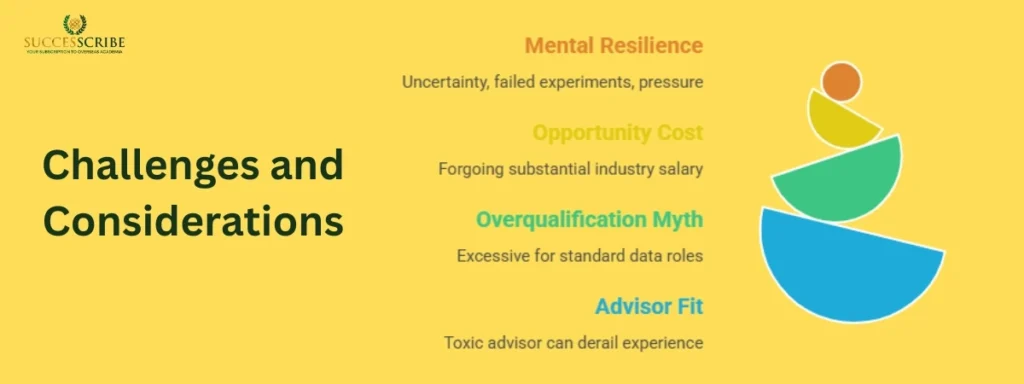
Pursuing a PhD is not merely an extension of undergraduate studies; it is a profound personal and professional commitment.
- Mental Resilience: The path is fraught with uncertainty, failed experiments, imposter syndrome, and intense pressure. Institutional support for graduate student mental health is a critical factor to evaluate.
- Opportunity Cost: Forgoing 5-6 years of industry salary (which can be substantial for talented CS/MS grads) is a significant financial consideration, even with a stipend.
- The “Overqualification” Myth (and Reality): While untrue for core research roles, a PhD may be seen as excessive for standard data engineering or business intelligence positions. Your job search must be targeted.
- Advisor Fit is Everything: A supportive, reputable, and well-funded advisor is more important than the university’s brand alone. A toxic advisor can derail the entire experience.
Conclusion
A PhD in Data Science in USA offers unmatched research exposure, global recognition, and strong long-term career returns. With full funding, cutting-edge infrastructure, and strong job demand, it remains one of the most prestigious doctoral pathways in 2026 for students passionate about data-driven innovation.
FAQs
Is PhD in Data Science in the USA fully funded?
Yes. The majority of PhD programs in Data Science in the USA are fully funded. Funding typically includes a full tuition waiver, a monthly or annual stipend, health insurance, and research or conference funding. Most students do not pay tuition out of pocket.
How long does it take to complete a PhD in Data Science in the USA?
A PhD in Data Science in the USA usually takes 4 to 6 years to complete. The duration depends on coursework requirements, research progress, publication output, and dissertation completion.
Is GRE required for PhD in Data Science in the USA in 2026?
In 2026, the GRE is optional or waived at many top universities. However, some technical institutions may still recommend or require it. When required, a strong quantitative score (165+) significantly strengthens an application.
What academic background is best for a PhD in Data Science?
Successful applicants commonly come from Computer Science, Statistics, Mathematics, Engineering, Physics, Economics, or related quantitative fields. A strong foundation in linear algebra, probability, optimization, and programming is more important than the degree title itself.
How much stipend do PhD students in Data Science receive?
In 2026, PhD stipends typically range from USD 25,000 to USD 42,000 per year, depending on the university, city, and funding source. Top private universities generally offer higher stipends.
Related Post
MBA scholarship in USA
MBA in USA without gmat
MBA in business analytics in USA
MBA in USA without work experience